Monday, October 04, 2021

Synergy: Hemispheres and Seasons

Earth is divided into the Northern and Southern Hemisphere by an imaginary line at the equator. The Earth’s tilt causes the seasons. During different months of the year, different part of the Earth receive more or less of the Sun’s direct rays depending on the Earth’s tilted axis.

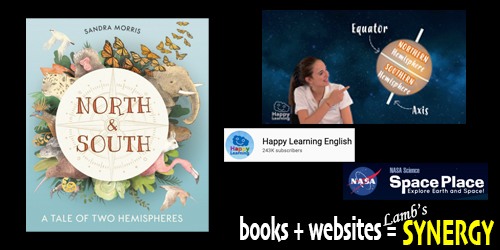
Read the recently published nonfiction picture book for youth, then learn more at the websites.

NORTH AND SOUTH: A TALE OF TWO HEMISPHERES by Sandra Morris explores how animals have adapted to the seasons in both the Northern and Southern Hemispheres. Combining engaging illustrations with informational text, two-page spreads explore animals from each hemisphere through the months of the year. Mini-maps of animal habitats and information about conservation status is also provided on each page. The end pages provide additional information about each animal.

NASA’s SPACEPLACE provides a page that answers the question “What Causes the Seasons?” In addition to explaining the seasons, it also discusses the hemispheres. The page includes useful illustrations along with links to additional resources.

To visit SpacePlace, go to https://spaceplace.nasa.gov/seasons/en/

THE SEASONS AND HEMISPHERES is a short YouTube video from Happy Learning English exploring both the seasons and the hemispheres.

To watch the video, go to https://youtu.be/qHgs8dcmB4M.

ARC courtesy of Candlewick, an imprint of Random House.


Tuesday, September 28, 2021

Timely Take-Aways for Life-Long Learning: Marine Life


The Brilliant Abyss: Exploring the Majestic Hidden Life of the Deep Ocean, and the Looming Threat That Imperils It
Helen Scales, Jul 2021, Grove/Atlantic
Themes: nature, ecosystems, marine life, oceans, deep seas

Underwater Wild: My Octopus Teacher’s Extraordinary World
Craig Foster & Ross Frylinck, Nov 2021, Mariner-Houghton Mifflin Harcourt
Themes: nature, marine life, ecology

Whether exploring the deepest oceans or learning about life from sea creatures, new works of nonfiction are examining the natural world in new ways.

THE BRILLIANT ABYSS takes readers on a voyage of discovery revealing the mysteries of the deep ocean. Scales’ rich narrative shares fascinating information about the bizarre creatures and diverse ecology increasingly threatened by pollution, mining, and climate change.

UNDERWATER WILD examines the marine science and incredible adventures that led to the award-winning documentary MY OCTOPUS TEACHER. Through stunning photos and engaging narrative, readers learn about the authors, their personal relationships, and the sea creatures that inspire them.

Let’s explore seven timely take-aways for life-long learners:


1) Deep-diving submersibles and other new technologies have opened up a “golden era for deep-sea exploration”. While scientists have detailed maps of the moon, much of the world’s deep seabed mountain ranges remain a mystery. A 2019 study suggests that large areas of the deep seafloor aren’t rocky. Instead, they’re covered with mud that’s one to six or more miles deep.
2) Recently, photographers captured 347,000 deep sea creatures and only 1 in 5 was previously known. These creatures thrive in extreme conditions. The diversity of life in the Pacific deep sea is immense.
3) Animal illuminations have led to some surprising adaptations among life in the deep. While some creatures have adapted by making light, others have evolved ultra-black skin packed with melanin.
4) The sea is warming much more rapidly than anticipated. This heat is flowing much deeper than anticipated. The melting ice caps are reducing the salinity of the seawater.
5) Every ocean has hydrothermal vents containing endemic creatures that thrive only near these vents. These ecosystems flourish because of chemosynthesis rather than photosynthesis.
6) In addition to climate change, plastic pollution and deep sea mining are other concerns. Deep sea sediments are filled with micro plastics that are consumed by marine life. Of particular note is the long range impact of tailings from mines.
7) From observing pyjama catshark reproduction to tracking otters, each individual creature plays an important role in the ecology of the sea. No creatures are insignificant. Simple observation shows the complexity of marine life.

Whether helping educators keep up-to-date in their subject-areas, promoting student reading in the content-areas, or simply encouraging nonfiction leisure reading, teacher librarians need to be aware of the best new titles across the curriculum and how to activate life-long learning. - Annette Lamb


Monday, September 27, 2021

Synergy: Banned Books Week


Banned Books Week is an annual Fall event celebrating the freedom to read. Launched in 1982, it seeks to promote awareness of book challenges and express support for intellectual freedom. The event is intended to draw attention to the harms of censorship.

Read the recently published nonfiction for young people, then learn more at the websites:

YOU CAN’T SAY THAT! compiled and edited by Leonard S. Marcus shares the experiences of thirteen authors for young people who have dealt with censorship. Each writer discusses their thoughts on free expression through interviews by the book’s compiler.

The BANNED BOOKS WEEK website is maintained by the ALA Office of Intellectual Freedom and Banned Book Weeks Coordinator in partnership with a coalition of groups supporting intellectual freedom. The website contains news, promotional tools, event information, virtual read-out videos and other useful resources.

To visit the website, go to https://bannedbooksweek.org/.

ARC courtesy of Candlewick Press.

Synergy: Do-It-Yourself

Do-It-Yourself (DIY) involves creating, modifying, or repairing things without the help of professionals. Coined in the early 20th century in the area of home improvement, today’s DIY projects include a wide range of topics that reflect growing interest in self-sufficiency. Makerspaces are an extension of this movement that often includes technology-based projects.

Read the recently published works of graphic nonfiction for youth, then learn more at the website.

The MAKER COMICS series combines the graphic novel genre with the step-by-step instruction of a DIY book. Books include FIX A CAR, BAKE LIKE A PRO, CREATE A COSTUME, DRAW A COMIC, and GROW A GARDEN.

SURVIVE IN THE OUTDOORS by Mike Lawrence is the latest release in the MAKER COMICS series. After a brief a safety reminder, readers follow siblings who are reluctant to leave their electronic devices for an outdoor adventure. From fishing and outdoor cooking to first aid and shelter, their grandfather helps them learn the basics of survival. The book concludes with additional tips.

Other upcoming titles in the series include CONDUCT A SCIENCE EXPERIMENT and LIVE SUSTAINABLY.

INSTRUCTABLES is a website containing endless DIY projects. Major sections of the website include circuits, workshop, crafts, cooking, living, outside, and teachers. The OUTSIDE area explores a wide range of outdoor project and contest ideas. The OUTDOOR SURVIVAL projects focus on activities such as filtering water, using a compass, and building shelter.

To visit Instructables, go to https://www.instructables.com/.

ARC courtesy of First Second, an imprint of Macmillan.

Monday, September 20, 2021

Synergy: Massacre


A massacre is the deliberate and brutal slaughter of multiple individuals. Often perpetrated against defenseless victims by those seeking political or social gain, these mass killings are often aimed at minority, racial, or ethnic groups. The 1921 Tulsa Race Massacre is an example.

Read the recently published works of nonfiction for youth, then learn more at the website.

BLACK BIRDS IN THE SKY by Brandy Colbert shares the story and legacy of the 1921 Tulsa Race Massacre. Emphasis is placed on the larger history of violence against African Americans as well as the Native Peoples who came before them. Of particularly note is the focus on active suppression of information about the event and how it connects to broader discussions of systemic racism.

THE BURNING by Tim Madigan was recently adapted for young people by Hilary Beard. In addition to an account of the Tulsa Race Massacre, the book explores the larger historical context along with a discussion of the need for social justice.

The TULSA RACE MASSACRE is an interactive article from The New York Times. Using maps, historical photos, and the stories of individuals, the project explores the prosperous Black community known as America’s Black Wall Street and the tremendous loss of life and property street-by-street. By telling the story of the individual people and places, readers become immersed in the time and place of the massacre.

To explore the interactive, go to https://nyti.ms/3k8l1J4.

ARC courtesy of Henry Holt and Harper Collins.

Monday, September 13, 2021

Synergy: Cold War Era


The Cold War Era is the time period from about 1947 to 1991 representing tensions between the United States and the Soviet Union along with their respective allies. Although there was no large-scale war between these superpowers, many regional conflicts were backed by each side. The struggle for dominance was reflected in acts of espionage, rivalries, and propaganda.

Read the recently published work of intermediate nonfiction, then learn more at the website.

FALLOUT: SPIES, SUPERBOMBS, AND THE ULTIMATE COLD WAR SHOWDOWN by Steve Sheinkin is a riveting nonfiction narrative exploring the clash of the world’s super powers in the decades after World War II. A follow-up to his book BOMB, the story is told in three parts and concludes with an epilogue. By kicking off with the story of a young paperboy who stumbles on a spy, the author skillfully draws readers into true stories of intrigue set within the larger context of the Cold War era. The fast-paced narrative jumps around, so readers will need to pay attention. Encourage readers to extend the experience through exploring key issues and perspectives beyond the text. The book’s use of primary sources and end notes added credibility to these amazing stories.

COLD WAR HISTORY is a Wilson Center Digital Archive sharing archival documents focusing on the Cold War era. These digitized primary source documents include previously secret archives from former communist countries. The website includes an interactive timeline along with collections, biographies and essays.

To visit the website, go to https://bit.ly/3BUp0Qj.

ARC courtesy of Roaring Brook Press, an imprint of Macmillan.

Monday, September 06, 2021

Synergy: Women’s History

Women’s history studies the role females played in history. This includes how women and their perspectives are (or aren’t) represented in standard historical references. Specifically, women’s history includes their struggle for equality and freedom along with recognition for contributions overlooked by traditional historical sources.

Read the recently published work of graphic nonfiction, then learn more at the website.

GOOD GIRLS DON’T MAKE HISTORY by Elizabeth Kiehner, Kara Coyle, and Keith Olwell is a powerful and visually stunning work of graphic nonfiction. Young adults will immediately connect with the contemporary issues of voter suppression including long lines to vote. Through short, focused vignettes, readers learn about women’s history while also exploring larger issues of enslaved people, indigenous people, and others facing challenges to their human rights. Weaving in lesser known stories along with well-known turning points, the graphic history includes images and references to primary source documents and quotes from key figures.

The WOMAN’S SUFFRAGE TIMELINE from the National Women’s History Museum contains dozens of key events in women’s history. The website also includes resources for students and educators along with biographies, articles, and online exhibits.

To explore the timeline, go to https://bit.ly/3x5lPSt.

To visit the National Women’s History Museum, go to https://womenshistory.org/

ARC courtesy of Wide Eyed Editions. Distributed by the Quarto Group.


Monday, August 30, 2021

Synergy: National Historic Trails

In the United States, national historic trails recognize original overland or water routes with historical significance. Nineteen trails have been established by acts of Congress. While many of these trails commemorate routes established during the westward movement of the mid-19th century, others trace their origins to prehistoric times.

Read the recently published informational picture book, then learn more at the website.

MY WAY WEST by Elizabeth Goss tells the true stories of children who traveled on the Oregon and California trails in the 19th century. Featuring quotes from primary sources such as letters and memoirs, readers learn about life on the trail. The book takes care to incorporate children from varied backgrounds including Native American and African American perspectives. The story begins by noting that the land was already occupied by Native peoples prior to the arrival of settlers. Each two-page spread focuses on a topic related to the journey such as the decision, the supplies, and bad weather. The book concludes with background information about over a dozen children represented in the book.

The NATIONAL HISTORIC TRAILS page at the National Park Service website provides access to information about nineteen historical trails that reflect routes of exploration, migration, struggle, and military action.

To visit the website, go to https://bit.ly/3iU1Ocv.

ARC courtesy of West Margin Press. Distributed by Ingram Publisher Services.

Monday, August 23, 2021

Synergy: Eons

Eons are chunks of time used to mark key events in the history of Earth including the history of life on our planet. Eons are the largest division of time and are subdivided into eras, periods, epochs, and ages.

Read the recently published informational picture book, then learn more at the YouTube Channel:

OUT OF THE BLUE written by Elizabeth Shreeve and illustrated by Frann Preston-Gannon describes how animals evolved from prehistoric seas. Each two page spread explores an eon, period, or era. The simple, accurate text along with the colorful illustrations and diagrams provide an effective introduction to the evolution of living things. The author skillfully weaves questions and answers into the narrative to bring together key concepts.

Eons is a YouTube Channel from PBS Digital Studios exploring the history of life on Earth. The episode, THE SEARCH FOR THE EARLIEST LIFE shares information about the earliest life on earth. Other videos explore topics related to the evolution of plants and animals through the eons.

To visit the channel, go to https://www.youtube.com/c/eons.
To watch the video, go to https://youtu.be/uCVnRIP3pIk.

ARC courtesy of Candlewick Press.

Monday, August 16, 2021

Synergy: Seasons

Seasons are a way to divide a year on Earth based on changes in daylight, weather, and living organisms. The seasons in the Northern and Southern Hemisphere are different because of the Earth’s axial tilt. Although traditionally divided into four seasons of spring, summer, autumn, and winter, some areas of the world recognize fewer or more seasons.

Read the recently published picture book, then learn more at the website:

IF YOU GO DOWN TO THE WOODS TODAY with poems by Rachel Piercy and illustrated by Freya Hartas is an engaging picture book exploring the woodland habitat through the seasons. Each two-page spread includes a descriptive poem and over a dozen things to find on the page. Primary grade teachers will find this book to be a fun read-aloud or engaging learning station option. Use it to jumpstart a discussion about the fact and fiction of woodland life. The book concludes with a nature trail revisiting the book’s content and encouraging children to get outside and explore nature.

50 THINGS TO DO BEFORE YOU’RE 11-3/4 is an activity list from UK’s National Trust. This handy resource describes dozens of ideas for encouraging young adventurers to explore nature through the seasons. Users can read the guide online, then download a wall chart as a PDF.

To learn more, go to https://bit.ly/3i50B2C.

ARC courtesy of Magic Cat Publishing, an imprint of ABRAMS.


Monday, August 09, 2021

Synergy: Tree


A tree is a woody perennial plant generally containing a trunk and lateral branches. A root system serves as an underground anchor using moisture and nutrients from the soil. Leaves grow from the shoots. Trees usually reproduce using seeds.

Read the informational picture book for youth, then learn more at the websites:

BE A TREE! written by Maria Gianferrari and illustrated by Felicita Sala skillfully balances poetic connections between trees and humans with useful facts for young scientists. This combination is intended to inspire young people to be kind members of their community as well as environmentally aware global citizens. This beautifully illustrated picture book concludes with an author’s note, anatomy of a tree illustration, additional resources, and calls for environmental and community action.

THANK YOU, TREES! from PBS KIDS PLUM LANDING provides a digital nature sketchpad where children can draw their own trees.

To draw a tree, go to https://to.pbs.org/34AFWMm.

THE TREE GUIDE from the Arbor Day Foundation provides a tree database, glossary, and a page about the anatomy of a tree.

To explore the website, go to https://bit.ly/2RbMmhU.

ARC courtesy of Abrams Books for Young Readers. 

Monday, August 02, 2021

Synergy: Wildlife


Wildlife are undomesticated creatures that live separate from direct human interference. Global populations of wildlife are rapidly decreasing due to human activity such as habitat destruction.

Read the informational picture book series for youth, then learn more at the websites:

GO WILD! is a new series for young readers from National Geographic Kids. SEA TURTLES is the first book in this informational reading collection for ages 4 through 8. Each title has a similar format including a two-page spread and topics such as habitat, map, size, anatomy, relatives, food, and babies. Pages related to conservation issues are likely to inspire children to care for these creatures. A timeline and glossary are useful for curriculum connections. Fun facts and activities extend the experience. The parallel format of each book makes them particularly useful for small group activities.

Upcoming titles in the series include PANDAS, ELEPHANTS, and LEMURS.

LEAVE WILD ANIMALS IN THE WILD is a short online article providing wildlife tips for children.

To read the article, go to https://bit.ly/3uGZOIg.

EXPLORE provides access to dozens of live streaming cameras students and educators can use to observe wildlife.

To view the cameras, go to https://explore.org/livecams.

ARC courtesy of National Geographic Kids.

Monday, July 26, 2021

Timely Take-Aways for Life-Long Learning: The Boone Family

Timely Take-Aways for Life-Long Learning


The Taking of Jemima Boone: Colonial Settlers, Tribal Nations, and the Kidnap That Shaped America
Matthew Pearl, October 2021, HarperCollins
Themes: history, United States, Revolutionary Period

Blood and Treasure: Daniel Boone and the Fight for America’s First Frontier
Boby Drury and Tom Clavins, April 2021, Macmillan
Themes: history, United States, 18th and 19th Century

From tragedy and hardship to strength and independence, the Boone family represents the passion and resilience of 18th-century settlers. Both new titles skillfully explore the experiences of the Boone family within the larger context of the people, places, and events that shaped early westward expansion.

THE TAKING OF JEMIMA BOONE is an absorbing work of narrative nonfiction that seamlessly weaves key people and historical events with the personal story of a strong young woman with a legendary father. Divided into three sections, the book explores the taking, the retaliation, and the reckoning.

BLOOD AND TREASURE examines the epic struggle over the lands west of the Appalachian Mountains. From Native American tribes trying to save their land from invaders to the settlers pushed west by an expanding nation, this carefully researched, engaging narrative shares the many perspectives of both legendary figures and ordinary people.

Let’s explore seven timely take-aways for life-long learners:
1) In popular art and literature of the 19th-century, Jemima Boone was portrayed as a passive victim of a Cherokee-Shawnee raiding party. In reality, she was a strong wilderness woman who used knowledge of her captors, delay tactics, and skills in trail marking to stay alive.

2) During the early days of America’s westward expansion, complex relationships, ever-shifting allegiances, and broken promises sparked violent clashes between and among Spanish, French, British, Colonial American, Indigenous, and Enslaved peoples. These conflicts and betrayals caused deep and lasting physical and emotional scars that impacted their future actions.

3) Cultural misunderstandings about property ownership, allegiance, and family structure were at the root of many clashes. Unlikely early biographies that often depicted Daniel Boone as a thrill-seeking Indian killer, he is increasingly respected for his patience and interest in studying cultural nuances.

4) Peaceful gatherings were held among people of different cultural backgrounds to avoid conflict when possible. For instance, Jemima Boone had met her captor Hanging Maw at such an event prior to the kidnapping. Daniel Boone was adopted into a Shawnee family and was viewed as both a captive and son.

5) During the 18th-century, hunters spent six months on expeditions known as “long hunts”. Daniel Boone was one of several well-known long hunters. In addition to gathering and processing animals, Boone collected valuable information from other explorers such as John Finley as well as his own pathfinding that was later used to establish Kentucky settlements.

6) Although most people associate Daniel Boone with Kentucky, he and his extended family including Jemima Boone Callaway moved to Missouri in 1799 where he spent the last twenty years of his life.

7) Despite inaccurate 19th-century biographies and works of fiction, Daniel Boone remains an iconic figure in American history. However, it continues to be difficult to separate the man from the myth.

Timely Take-Aways for Life-Long Learning
Whether helping educators keep up-to-date in their subject-areas, promoting student reading in the content-areas, or simply encouraging nonfiction leisure reading, teacher librarians need to be aware of the best new titles across the curriculum and how to activate life-long learning. - Annette Lamb, Teacher Librarian: The Journal for School Library Professionals

Synergy: Comparative Adjectives


Comparative adjectives are words that share differences between the two objects they modify such as faster, colder, messier, or happier.

Read the informational picture book for youth, then learn more at the websites:

COMPARROTIVES by Janik Coat is the latest book in the Grammar Zoo series geared to a preschool audience. Featuring seventeen, two-page spreads, this oversized board book is an engaging way to teach children about comparative adjectives. Although designed for young children, the book is also useful with older children reviewing grammar rules. Other books in the series include HIPPOPPOSITES, RHYMOCEROS, and LLAMAPHONES.

COMPARATIVES GRAMMAR is a short animation that uses humor to introduce grammar concepts.

To view the video, go to https://youtu.be/2fQb7_KUs3A.

ARC courtesy of Abrams Appleseed, an imprint of Abrams.

Monday, July 19, 2021

Synergy: Camouflage


Camouflage is a defense mechanism used by creatures to blend into their environment. Also called cryptic coloration, these organisms are able to disguise their appearance, location, and even movement.

Read the informational picture book for youth, then learn more at the websites:

MASTERS OF DISGUISE: CAMOUFLAGING CREATURES & MAGNIFICENT MIMICS by Marc Martin uses brightly colored watercolor and cut-outs to explore the world of biomimicry in nature. Featuring a dozen animals from around the world, readers learn about how each creature is able to blend into its natural habitat. Of particular note are the seek-and-find activities woven throughout the book to get students thinking about the importance of observation in the natural world.

CAN YOU FIND THE CAMOUFLAGED ANIMALS? from Earth Rangers shows viewers an image and asks them to identify the creature. After revealing the answers, viewers learn facts about the creature. This video would be effective as a whole class, small group, or individual activity.

To view the video, go to https://youtu.be/kGZX1_Zy-74.

32 EXAMPLES OF CAMOUFLAGE IN NATURE is an online article containing lots ideas educators can use to teach about how predators and prey animals use camouflage.

To read the article, go to https://bit.ly/34FJXiJ.

ARC courtesy of Candlewick Press.

Wednesday, July 14, 2021

Timely Take-Aways for Life-Long Learning: Auschwitz


The Sisters of Auschwitz: The True Story of Two Jewish Sisters’ Resistance in the Heart of Nazi Territory
Roxane van Iperen, August 2021, HarperCollins
Themes: history, Jewish, World War II, Holocaust
The Auschwitz Photographer: The Forgotten Story of the WWII Prisoner Who Documented Thousands of Lost Souls
Luca Crippa, Maurizio Onnis, Jennifer Higgins (translated by)
September 2021, Sourcebooks
Themes: history, biography, survival, World War II, Holocaust
The Dressmakers of Auschwitz: The True Story of the Women Who Sewed to Survive
Lucy Adlington, September 2021, HarperCollins
Themes: history, Jewish, World War II, Holocaust
Since the end of World War II, many nonfiction works have shared the horrific atrocities of Auschwitz. However, three recent titles explore the Holocaust from unusual perspectives including a photographer, dressmakers, and sisters. These powerful stories chronicle the variety of ways prisoners were able to survive.
THE SISTERS OF AUSCHWITZ shares the story of two sisters who joined the Dutch Resistance. From publishing an underground newspaper to hiding refugees, they were working at a resistance center when betrayed and sent to Auschwitz.
THE DRESSMAKERS OF AUSCHWITZ examines the experiences of seamstresses who survived the gas chambers by creating high fashion dresses for elite Nazi women. At the same time, these brave women played a role in camp resistance.
THE AUSCHWITZ PHOTOGRAPHER tells the true story of Wilhelm Brasse who recorded the horrors of the deadliest concentration camp in WWII. He was first assigned to the photographic identification unit and later to Josef Mengele’s horrific laboratory. He survived by taking 50,000 photographs over a five year period.
Let’s explore seven timely take-aways for life-long learners:
  1. Jewish sisters Janny and Lien Brilleslijper were active in the Dutch resistance. They were with Anne Frank and her family on the train to Auschwitz.
  2. The High Nest is an example of a secret refuge near Amsterdam that served as an important safe house during World War II.
  3. The Upper Tailoring Studio was a fashion workshop housed at Auschwitz and created to cater to the wives of SS officers and Berlin’s wealthy Nazis.
  4. Two dozen women prisoners sewed elegant gowns from fabrics and clothing plundered from across Europe.
  5. Wilhelm Brasse was able to save thousands of photographs that provided evidence of Nazi atrocities including human experiments.
  6. Upon entering Auschwitz, identity portrait photographs were taken of each prisoner including from the front and each side.
  7. From nurses and dressmakers to photographers, those who were selected to work at Auschwitz were more likely to survive than other prisoners.
Timely Take-Aways for Life-Long Learning
Whether helping educators keep up-to-date in their subject-areas, promoting student reading in the content-areas, or simply encouraging nonfiction leisure reading, teacher librarians need to be aware of the best new titles across the curriculum and how to activate life-long learning. - Annette Lamb, Teacher Librarian: The Journal for School Library Professionals

Monday, July 12, 2021

Synergy: Vaccination

Vaccination is the process of administering a vaccine. Vaccines are used to prevent illness from an infectious disease such as smallpox or polio. Vaccines work by helping the patient’s immune system develop protection from the disease.

Read the work of graphic science for youth, then learn more at the websites:

A SHOT IN THE ARM! by Don Brown is the third book in the “Big Ideas that Changed the World” series of juvenile nonfiction graphic science books. From smallpox to COVID-19, this engaging graphic science book examines the history of deadly disease and the essential role of vaccinations in saving lives. Told through high-quality, engaging illustrations and concise text, this timely work shares the science behind vaccinations and the key scientists who have made them possible. Although the book primarily on the history of smallpox, other diseases are also woven into the story.

THE HISTORY OF VACCINES provides a timeline, articles, and activities exploring the development and use of vaccines through time.

To visit the website, go to https://www.historyofvaccines.org/.

THE UNTOLD STORY OF THE FIRST VACCINE from SciShow shares the long history of smallpox and how medical breakthroughs across thousands of years lead to the vaccine.

To watch the video, go to https://youtu.be/jtqAqL3fn64.

VACCINES 101 from Nature is a short video describing how vaccines work in the human body.

To watch the video, go to https://youtu.be/4SKmAlQtAj8.

ARC courtesy of Amulet Books an imprint of Abrams.