Monday, January 24, 2022

Synergy: Protest Art


Protest Art includes the wide range of creative works produced by activists. Designed to inform, educator, and persuade, these works of art are intended to stir emotions and promote action in citizens as part of social movements.


Read the recently published work of nonfiction for youth then learn more at the website.


THE ART OF PROTEST: Creating, Discovering, and Activating Art for your Revolution by De Nichols is designed to inspire youth to explore art from around the world and create their own. Using colorful illustrations and well-known examples from throughout history, the author explains the importance of art in social movements, the creation or protest art, the power of youth leadership, and the future of this art form.


THE 25 MOST INFLUENTIAL WORKS OF AMERICAN PROTEST ART SINCE WORLD WAR II is an article from the New York Times discussing the impact of protest art through specific examples.


To read the article, go to https://nyti.ms/33mEIaK 


ARC courtesy of Big Picture Press, an imprint of Candlewick Press.

Monday, January 17, 2022

Synergy: Farm Security Administration


The Farm Security Administration (FSA) was part of the Great Depression-era New Deal program. The FSA became famous for its photography program that depicted rural poverty. Between 1935 and 1944, about 175,000 black-and-white images were generated by the eleven photographers. Dorothea Lange and Gordon Parks were among the photographers.


Read the recently published nonfiction history for youth then learn more at the website.


PICTURING A NATION by Martin W. Sandler shares the story of the FSA photographers who brought the challenges of rural living alive for America. Filled with stunning photographs and quotes from both the photographers and others, the book features many lesser-known images to help young people understand the impact of the Farm Security Administration’s photography program. After introducing the program, the book explores photographs from each region and concludes with an overview of each photographer.


The FARM SECURITY ADMINISTRATION digital collection at the Library of Congress shares thousands of historical photos along with articles and essays about the FSA-OWI photographic unit.

To visit the black and white collection, go to https://bit.ly/3FBBZHi

To visit the color collection, go to https://bit.ly/3Igrbjs


ABOUT THE FSW is a video from the Library of Congress that introduces the Farm Security Administration collection.

To watch the overview, go to https://youtu.be/00UaD8_UpkE


ARC courtesy of Candlewick Press.


Saturday, January 15, 2022

Timely Take-Aways for Life-Long Learning: Medieval Life

New Takes on Medieval Life

New works of nonfiction bust myths about the people and progress of the Middle Ages by providing new perspectives on this often misunderstood time period.

The Middle Ages: A Graphic History
Eleanor Janega, Sep 2021, Icon Books
Themes: graphic history, European history, Middle Ages, Medieval

THE MIDDLE AGES is a highly illustrated history of Medieval times. Combining engaging visuals with a conversational approach, this graphic history provides a useful overview with many specific examples and lots of fun along the way.

Take-aways: Rather than a dark period in history, Janega stresses that Medieval times featured art, culture, and intellectual development. Contains lots of ideas for reluctant learners and useful examples. 


Powers and Thrones: A New History of the Middle Ages
Dan Jones, Nov 2021, Viking/8 Titles
Themes: Europe history, Middle Ages, Medieval

POWERS AND THRONES explores a thousand years of medieval history. Divided into four parts: imperium, dominion, rebirth, and revolution, each section explores key individuals, transformational events, and enduring themes

Take-aways: Of particular note is Jones’ global approach to this time period while maintaining a mostly western lens. Young adults will enjoy the author’s conversational approach and themes of interest to contemporary readers.


The Bright Ages: A New History of Medieval Europe
Matthew Gabriele & David M. Perry, Nov 2021, Harper Collins
Themes: European history, Middle Ages, Medieval

THE BRIGHT AGES casts a new light on well-known people and events of the European Middle Ages. The book begins with the story of a Roman woman artisan and concludes with a debate about the prospects of the New World.

Take-aways: Gabriele and Perry help readers understand why long-held beliefs about the backward nature of the dark ages need to be replaced by an understanding of the time period that includes a broader, more diverse, and more inclusive view.


Medicine in the Middle Ages: Surviving the Times
Juliana Cummings, Dec 2021, Pen and Sword History
Themes: Medical history, Middle Ages, Medieval

MEDICINE IN THE MIDDLE AGES describes the perils of medieval life and how these people approached healing. Rooted in the work of ancient Greek and Roman philosophers, medieval medicine was linked to both the Catholic Church and the social status of patients. Explore the birth of hospitals and the horrors of war.

Take-aways: Educators will find this book useful in helping their students understand the challenges faced by both the rich and poor of the middle ages. From science and social studies to history, this book takes a multi-disciplinary approach to exploring the connection among religion, torture, plagues, medicine, and disease.

Whether helping educators keep up-to-date in their subject-areas, promoting student reading in the content-areas, or simply encouraging nonfiction leisure reading, teacher librarians need to be aware of the best new titles across the curriculum and how to activate life-long learning. - Annette Lamb

Monday, January 10, 2022

Synergy: Africa


Africa is the world’s second-largest continent covering 20% of the Earth’s land area. With the world’s youngest population, it accounts for 16% of the world’s population. Its human history can be traced back at least 200,000 years. Recorded history arose in Ancient Egypt and later in Nubia, the Sahel, the Maghreb, and the Horn of Africa.


Read the recently published nonfiction history for youth then learn more at the website.


AFRICAN ICONS by Tracey Baptiste tells the story of ten people who shaped African history. From ancient civilizations to the sixteenth century, each profile represents a key individual who made a unique contribution. Each short chapter begins with a full-color portrait, then shares the fascinating true story of a visionary leader or thinker. A map identifies the location of each story, provides a timeline of regions, and features key innovations.


AFRICA’S GREAT CIVILIZATIONS is a PBS series exploring the history of Africa. Featuring Henry Louis Gates, Jr., the six hour series examines two hundred thousand years of history.


To visit the website, go to https://to.pbs.org/3CBvhAA.


ARC courtesy of Algonquin Young Readers, an imprint of Workman.

Monday, January 03, 2022

Synergy: Louisa May Alcott


Louisa May Alcott (1832-1888) is an American author best known for her novel Little Women. She worked to support her family from a young age and used pen names to publish her work. Based on her childhood experiences, Little Women was published in 1868 leading to several other novels. 


Read the recently published biography for youth then learn more at the website.


SCRIBBLES, SORROWS, AND RUSSET LEATHER BOOTS by Liz Rosenberg tells the story of author Louisa May Alcott’s experiences living in nineteenth-century New England. Based on primary sources including journals and letters, the well-researched biography covers her entire life including her efforts with reform movements and caring for her family.


Louisa May Alcott’s Orchard House website contains a photo gallery and information about the home where Alcott wrote Little Women. It also contains biographical sketches of the Alcott family members. The digital discovery section features audio, video, and educational resources.


To visit the website, go to https://louisamayalcott.org/.


ARC courtesy of Candlewick, an imprint of Candlewick Press.

Saturday, January 01, 2022

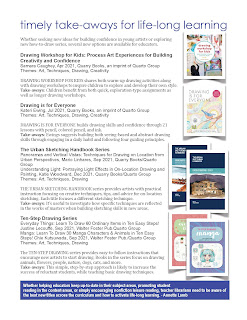
Timely Take-Aways for Life-Long Learning: Drawing


Timely Take-Aways for Life-Long Learning:
Drawing

Whether seeking ideas for building confidence in young artists or exploring new how-to-draw series, several new drawing books are available for educators.


Drawing Workshop for Kids: Process Art Experiences for Building Creativity and Confidence
Samara Caughey, Apr 2021, Quarry Books, an imprint of Quarto Group
Themes: Art, Techniques, Drawing, Creativity

DRAWING WORKSHOP FOR KIDS shares both warm-up drawing activities along with drawing workshops to inspire children to explore and develop their own style.

Take-aways: Children benefit from both quick, exploration-type assignments as well as longer drawing workshops.


Drawing is for Everyone 
Kateri Ewing, Jul 2021, Quarry Books, an imprint of Quarto Group
Themes: Art, Techniques, Drawing, Creativity

DRAWING IS FOR EVERYONE builds drawing skills and confidence through 21 lessons with pencil, colored pencil, and ink.

Take-aways: Ewings suggests building both seeing-based and abstract drawing skills through engaging in a daily habit and following four guiding principles.


The Urban Sketching Handbook Series

Panoramas and Vertical Vistas: Techniques for Drawing on Location from Urban Perspectives, Mario Linhares, Sep 2021, Quarry Books/Quarto Group

Understanding Light: Portraying Light Effects in On-Location Drawing and Painting, Katie Woodward, Dec 2021, Quarry Books/Quarto Group

Themes: Art, Techniques, Drawing

THE URBAN SKETCHING HANDBOOK series provides artists with practical instruction focusing on creative techniques, tips, and advice for on-location sketching. Each title focuses a different sketching technique.

Take-aways: It’s useful to investigate how specific techniques are reflected in the works of masters when building sketching skills in new areas.


Ten-Step Drawing Series

Everyday Things: Learn To Draw 60 Ordinary Items in Ten Easy Steps!

Justine Lecouffe, Sep 2021, Walter Foster Pub.Quarto Group

Manga: Learn To Draw 30 Manga Characters & Animals in Ten Easy Steps! Chie Kutsuwada, Sep 2021, Walter Foster Pub./Quarto Group

Themes: Art, Techniques, Drawing

The TEN-STEP DRAWING series provides easy-to-follow instructions that encourage new artists to start drawing. Books in the series focus on drawing animals, flowers, people, nature, dogs, cats, and more. 

Take-aways: This simple, step-by-step approach is likely to increase the success of reluctant students, while teaching basic drawing techniques.


Whether helping educators keep up-to-date in their subject-areas, promoting student reading in the content-areas, or simply encouraging nonfiction leisure reading, teacher librarians need to be aware of the best new titles across the curriculum and how to activate life-long learning. - Annette Lamb

Monday, December 27, 2021

Synergy: Giant Panda


Giant Pandas are a black and white bear native to South Central China. They eat bamboo shoots and leaves. Governments and organizations have worked together to ensure this vulnerable species is able to survive in the wild and in captivity.


Read the recently published picture book then learn more at the website.


BEI BEI GOES HOME: A PANDA STORY by Cheryl Bardoe tells the true story of a rare giant panda born at the National Zoo in Washington DC. The fast-paced narrative incorporates full-color photos and side-bar panda facts to engage readers. The picture book concludes with additional information about pandas.


The GIANT PANDA CAM page from the Smithsonian’s National Zoo provides feeds from two video cameras. In addition, still and video images are also available.


To visit the live cams, go to https://s.si.edu/3CBHwwX.


ARC courtesy of Candlewick Entertainment, an imprint of Candlewick Press.

Monday, December 20, 2021

Synergy: Architecture


Architecture is the art, science, and practice of designing and constructing structures such as buildings, bridges, and outdoor spaces.


Read the recently published work of nonfiction for youth then learn more at the website.


ADVENTURES IN ARCHITECTURE FOR KIDS by Vicky Chan is the second book in the new Design Genius Jr. series. The book features 30 design projects for children. Each hands-on activity explores a different aspect of STEAM discovery and learning associated with the architecture theme including general construction, architecture and history, landscape architecture, sustainable architecture, and city planning. Each project provides an overview, materials and tools needed, step-by-step instructions with photographs, and notes.


Architecture at Home is a web-based project from the Center for Architecture featuring two dozen, hands-on architecture activities for children. These short, easy design projects use readily available materials. Each project includes an overview, videos, step-by-step instructions, and a downloadable PDF.


To learn more, go to https://bit.ly/2ZKb0u4.


Use the book and website in a makerspace exploring architecture themes.


ARC courtesy of Rockport Publishers, an imprint of the Quarto Group.

Wednesday, December 15, 2021

Timely Take-Aways for Life-Long Learning: Popular Science Topics


Timely Take-Aways for Life-Long Learning
Popular Science Topics

New works of popular science nonfiction are examining fascinating scientific themes through entertaining stories. Educators will find these useful in identifying timely examples for their classrooms.

Fuzz: When Nature Breaks the Law
Mary Roach, Sep 2021, W.W. Norton & Company
Themes: science, social science, nature, biology, philosophy, wildlife

FUZZ explores the science of human-wildlife interaction and conflict. Combining the disciplines of human behavior and wildlife biology, Roach shares fascinating and often humorous examples of the challenges of human-nature coexistence.

Take-aways: Roach’s conversational style is always popular with young adults and educators alike. From connections with bears and elephants to monkeys and trees, each chapter shares a short, engaging narrative that helps readers understand the complex relationships between nature and humans.


Blue: In Search of Nature’s Rarest Color
Kai Kupferschmidt, Jul 2021, The Experiment, an imprint of Workman
Themes: science, physics, optics, light, color

BLUE take readers on an adventure around to globe to identify examples of this rare color in minerals, animals, and plants. It also examines the science behind the color blue and its impact on human life.

Take-aways: Occurring less frequently in nature than other colors, blue is a color associated with both science and social science topics.


Pump: A Natural History of the Heart
Bill Schutt, Sep 2021, Algonquin Books, an imprint of Workman
Themes: science, life science, biology, circulation, heart

PUMP shares the evolutionary history of circulation and specifically the heart. Weaving together scientific observations with cultural connections, Schutt examines the history of this organ through amazing stories and examples.

Take-aways: Use examples from PUMP to help youth see how our understanding of the circulatory system has evolved over time.


Weirdness!: What Fake Science and the Paranormal Tell Us About the Nature of Science
Taner Edis, Nov 2021, Pitchstone Publishing, Independent Publishers Group
Themes: science, scientific theory, pseudo-science, paranormal


WEIRDNESS! celebrates the importance of science in a world of fake news, social media, and conspiracy theories. Edis describes the critical role of science, while exploring the bizarre beliefs that have become prevalent in today’s society.

Take-aways: Use Edis’ examples to jumpstart meaningful discussions about the importance of science and need to understand the “weirdness” in our world.

Whether helping educators keep up-to-date in their subject-areas, promoting student reading in the content-areas, or simply encouraging nonfiction leisure reading, teacher librarians need to be aware of the best new titles across the curriculum and how to activate life-long learning. - Annette Lamb

Monday, December 13, 2021

Synergy: Black Seminole People


The Black Seminole people are the descendants of Seminole Indians combined with free Blacks and escaped enslaved people of African lineage. Although Florida had been a refuge for freedom-seeking enslaved people, the Black Seminole people ultimately migrated to Oklahoma, Texas, and Mexico in the mid 1800s.


Read the recently published biography for youth then learn more at the websites.


A MAN CALLED HORSE by Glennette Tilley Turner tells the true story of a man of Seminole and African descent who lead his people from Florida to a new home in the West during the 19th century. This well-researched biography reflects the many roles of John Horse from counselor and army captain to conductor on the Underground Railroad. Told through short, visually-rich chapters, Turner follows John Horse’s quest while also providing the larger context of the challenges facing the Black Seminole people. The book concludes with the lasting legacy, additional information, timeline, author’s note, notes, and bibliography.


Rebellion: John Horse and the Black Seminoles is an online project telling the story of John Horse and the Black Seminoles.


To visit the website, go to http://www.johnhorse.com/.


Florida’s Underground Railroad: The Black Seminoles is an online article from Florida Memory describing how runaway slaves fled south into Florida during the 18th and early 18th centuries. 


To learn more, go to https://bit.ly/3waqPX8.


Black Seminole Indians by Tracé Etienne-Gray is an online article tracing this ethnic group from Florida to their migration to Oklahoma, Mexico, and Texas.


To read the article, go to https://bit.ly/2Yaxowe.


ARC courtesy of Abrams Books for Young Reads, an imprint of ABRAMS.

Monday, December 06, 2021

Synergy: Color Theory


Color theory involves concepts and design guidance connected with color combinations and aesthetics. For instance, a color wheel is a circle containing colored sections showing the relationships among colors such as primary, secondary, and tertiary colors. Color harmony refers to combinations that are aesthetically pleasing together.


Read the three recently published informational picture books for children then learn more at the website.


The NATURE’S WONDERFUL COLORS series written by Jana Sedláčková and Štěpánka Sekaninová is designed for readers interested in how color is reflected the natural world. Illustrated by Magdalena Konečná, each two-page spread features hand-painted watercolor illustrations that are likely to inspire both nature and art lovers. 


COLORS IN NATURE explores a dozen colors and how they are reflected in the natural world. Readers also explore the color wheel and mixing colors.


COLORS OF HABITATS shares the rich colors found in biomes from around the world. Color names and swatches found on each page encourage artists to explore color harmony in nature.


SHAPES AND PATTERNS IN NATURE presents readers with examples of how patterns and shapes are found in plants, animals, and minerals. Whether examining fish scales, flower petals, or fruit cross-sections, the author reveals a fascinating world of forms in nature.


UX PLANET’s website shares four master artists who used nature-inspired color palettes. Use the resources and paintings on this page to inspire young artists to think about applying nature’s colors to their artwork.


To read the article, go to https://bit.ly/3bwUoZu. 


The article 9 AMAZING ARTISTS by Wynita Harmon shares works of art that inspire nature-related art projects for children.


To read the article, go to https://bit.ly/3nNePXI.


ARC courtesy of Albatros Media, an imprint of Ingram Publisher Services.

Monday, November 29, 2021

Synergy: Crazy Horse and George Armstrong Custer


Crazy Horse (Tashunka Witco) was a Lakota warrior of the Oglala Band who joined in the resistance against the reservation system and threats to his people’s traditional way of life.


George Armstrong Custer rose through U.S. military ranks to become a lieutenant colonel. He led campaigns to enforce the reservation system.


Crazy Horse and Custer met for the last time at the Battle of the Little Bighorn where Custer was killed. Although Crazy Horse continued to fight for another six months, he ultimately surrendered to protect his band.


Read the recently published work of nonfiction for youth then learn more at the website.


CRAZY HORSE AND CUSTER: BORN ENEMIES by S.D. Nelson is a compelling, dual biography exploring the parallels between two 19th century leaders with opposing viewpoints. Young readers will enjoy the fast-paced approach featuring short, engaging narratives. Along with period photographs and paintings, Nelson produced stunning full-color illustrations inspired by Plains Indians ledger art. The book concludes with an author’s note, timeline, end notes, and a bibliography.


The Little Bighorn Battlefield National Monument website provides information and resources related to the encounter between U.S. Cavalry soldiers and Northern Plains Indian tribes. Known as the Battle of Greasy Grass by the Lakota, the website explores multiple perspectives on one of the last armed efforts of indigenous people to preserve their way of life. The website describes the epic encounter, shares a photo gallery, provides biographical sketches of key individuals, and identifies key locations.


To learn more, go to https://www.nps.gov/libi.


Use these resources to inspire youth to explore multiple perspectives related to other connected individuals in history.


ARC courtesy of Abrams Books for Young Readers.

Monday, November 22, 2021

Synergy: Engineers


Engineers invent, design, construct, and test a wide range of machines, systems, and structures. Bridges, buildings, and other physical structures are just a few of their projects. Although many professional are involved in these projects, engineers apply math and physics to create innovative solutions to address the world’s problems from homes that use less space to energy efficient buildings.


Read the recently published picture book for youth then learn more at the website.


COLOSSUS written by Colin Hynson and illustrated by Giulia Lombardo shares the world’s most amazing feats of engineering. From buildings and bridges to monuments from around the world, this large format picture book uses annotated illustrations to trace the history of engineering projects from the ancient world to the present and future. The book concludes with a glossary and index.


SEVEN WONDERS: ENGINEERING FEATS is a StoryMap from the American Society of Civil Engineers. The web page features modern engineering marvels from around the world. Each structure includes an image, description and map showing its location.


To learn more, go to https://bit.ly/3Ex3DoL


ARC courtesy of Big Picture Press, an imprint of Candlewick Press.

Wednesday, November 17, 2021

Timely Take-Aways for Life-Long Learning: America's History of Enslaved People


Three recent works of nonfiction focus on America’s history of slavery and evolving narratives regarding acknowledgement of enslaved people.

William Still: The Underground Railroad and the Angel at Philadelphia
William C. Kashatus; April 2021; University of Notre Dame Press/Longleaf
Themes: history, social science, biography, African American & Black Studies

Set within the context of the broader anti-slavery movement, William C. Kashatus tells the compelling story of William Still, a key leader of the Underground Railroad and early civil rights advocate. Of particular note is the detailed database of the 995 runaway slaves who William Still helped escape between 1853 and 1861 which provides priceless information about each individual.


On Juneteenth
Annette Gordon-Reed; May 2021; Liveright/W. W. Norton
Themes: history, social science, memoir, African American & Black Studies

Blending both heart-wrenching and uplifting personal anecdotes about growing up Black in Texas with key historical events and stories, Annette Gordon-Reed takes readers on a journey through history with connections for today.


How the Word is Passed: A Reckoning with the History of Slavery Across America
Clint Smith; June 2021; Little, Brown and Company/Hachette Book Group
Themes: history, social science, memoir, African American & Black Studies

A travelogue, a memoir, a history, and a powerful reckoning… Clint Smith shares his experiences visiting sites connected with the history of enslaved people from Africa to the United States.


Let’s explore seven timely take-aways for life-long learners:

  1. Free black abolitionist William Still coordinated activities of the Eastern Line of the Underground Railroad in Philadelphia. The detailed records kept by Still in the mid-nineteenth century about escaped slaves provide a priceless tool for researchers exploring the African American enslavement experience.
  2. Those involved with the anti-slavery and later civil rights movements often disagreed about the best approach to address abolition, the plight of enslaved peoples, and the aftermath of slavery.
  3. Juneteenth refers to June 19, 1865. On this date, the news arrived in Galveston Texas proclaiming the end of slavery and defeat of the Confederacy (General Order No. 3).
  4. Although long celebrated by Black Texans, Juneteenth has recently become part of the national conversation and ongoing battle to acknowledge the racism and battle for civil rights in America.
  5. The nationalist-oriented, conventional narrative of American history comes from a white, English-speaking perspective closing off varied influences and viewpoints.
  6. Many historical sites are working toward a more truthful approach to the discussion of enslaved people. 
  7. While some historical sites are striving to fill the gaps with a more accurate picture of their connection to slavery, others are finding the process of reconciliation a challenge.

Whether helping educators keep up-to-date in their subject-areas, promoting student reading in the content-areas, or simply encouraging nonfiction leisure reading, teacher librarians need to be aware of the best new titles across the curriculum and how to activate life-long learning. - Annette Lamb

Monday, November 15, 2021

Synergy: Tutankhamun


Best known as King Tut, Tutankhamun (c.1341-1323 BC) was an ancient Egyptian pharaoh. In 1922, Tutankhamun’s nearly undisturbed tomb containing thousands of artifacts was discovered by two British adventurers along with Egyptian workers. Deaths associated with the discovery of Tutankhamun’s mummy have led to legends about a curse.  


Read the recently published nonfiction narrative for youth then learn more at the website.


THE CURSE OF THE MUMMY by Candace Fleming is an engaging work of nonfiction narrative immersing reader in the well-known stories of the excavation and aftermath. While each chapter begins with a spooky reference to the curse, the body of the narrative traces the story of the expedition. Of particular note is the inclusion of the Egyptian perspective and issues about ownership of artifacts. Historical photographs and drawings bring the story to life.


TUTANKHAMUN’S TREASURES is part of the National Geographic Lost Treasures of Egypt series exploring archaeological digs in the Valley of Kings. This episode uses new technology to discover how the tomb remained hidden for so long and examines the contents. 


To watch the video, go to https://youtu.be/-obKX-mqjXQ.


ARC courtesy of Scholastic.

Monday, November 08, 2021

Synergy: Nanotechnology


Nanotechnology involves the use of matter on a very tiny scale. Atoms and molecules are manipulated for fabrication of products for various industries including nano medicine, nano electronics, and biomaterials.

Read the recently published picture book for children then learn more at the website.

NANO by Jess Wade and illustrated by Melissa Castrillon describes the science of nanotechnology. This engaging picture book provides an introduction to atoms, the elements, and basic science concepts. Designed to inspire young scientists, it focuses on how nano materials are used in every day life. Key terms are highlighted in the text. The book concludes with more detailed information about nano science.

NANO.GOV is the website of the National Nanotechnology Initiative. The website contains information for scientists, educators, and students. The Nano 101 section features key concepts related to nanotechnology. The Educational Resources section includes useful learning materials for both students and teachers such as links to the e-zine Nanooze, information about the NanoDays festival, and access to the VizLab image collection.

To learn more, go to https://www.nano.gov/.

ARC courtesy of Candlewick Press.

Monday, November 01, 2021

Synergy: John Lewis


John Lewis (1940-2020) was a Georgia congressman and civil rights leader. From 1963-1966, he was the chairman of the Student Nonviolent Coordinating Committee (SNCC). In addition, he was one of the key organizers for the 1963 March on Washington and led the first of three Selma marches.

Read the recently published graphic memoir then learn more at the website.
RUN: BOOK ONE by John Lewis and Andrew Aydin is a companion to the MARCH graphic memoir series. Set after the 1965 Selma marches, this graphic history focuses on John Lewis’ continuing role leading grassroots Civil Right and social justice efforts. The gray-scale comic-style illustrations by L. Fury with Nate Powell combined with hand-drawn reproductions of primary sources such as letters and newspapers add to the reading and learning experience. The book concludes with biographical sketches of key individuals involved with the movement and fascinating notes about specific events connected with the narrative.
The Student Nonviolent Coordinating Committee (SNCC) Digital Gateway explores the history and work of this group. From leading voter registration efforts to building grassroots movements, the SNCC documentary website features the work of young activists in empowering the Black community.
To learn more, go to https://snccdigital.org/.
ARC courtesy of First Second.

Monday, October 25, 2021

Synergy: Pura Belpré Award


The Pura Belpré Award is named after the first Latina librarian in the New York Public Library system. Established by divisions and affiliates within the American Library Association, the annual award is given to a Latinx author or illustrator who “best portrays, affirms, and celebrates the Latino cultural experience” in a work of children’s literature.

Read the recently published picture book biography for children then learn more at the website.

PURA’S CUENTOS by Annette Bay Pimentel is a tribute to librarian and bilingual storyteller Pura Belpré. After arriving in New York from Puerto Rico, Pura Belpré finds that the library lacks children’s books about her homeland. She decides to share the stories of her youth and ultimately writes her own children’s book. Children will be attracted to the bright colored illustrations and educators will enjoy the book as a read-aloud. The title concludes with an author’s note and biography.

The Pura Belpré Award website is maintained by ALA’s Association for Library Service to Children. The website contains information about the award and a complete list of medal and honor books.

To learn more, go to https://www.ala.org/alsc/awardsgrants/bookmedia/belpre.

ARC courtesy of ABRAMS.

Wednesday, October 20, 2021

Timely Take-Aways for Life-Long Learners: Vikings

Explore three new works of nonfiction focusing on the Viking experience.

The Viking Heart: How Scandinavians Conquered the World
Arthur Herman, August 2021, Mariner Books/Houghton Mifflin Harcourt
Themes: history, Vikings, Europe, Scandinavia, expeditions
From their role as foreign invaders to their contributions as settlers and global citizens, Herman effectively engages readers in the history of the Vikings as they explored the world seeking both conquest and a better life for their families.

The Last Viking: The True Story of King Harald Hardrada
Don Hollway
September 2021, Osprey/Macmillan
Themes: history, Vikings, medieval, military, biography
This fast-paced work of nonfiction narrative weaves together a wide range of historical accounts and legends to tell the true story of King Harald Hardrada of Norway. This larger than life Viking warrior traversed the world seeking vengeance, passion, and power.

Armies of the Vikings, AD 793-1066: History, Organization & Equipment
Gabriele Esposito, October 2021, Pen & Sword Military
Themes: history, Vikings, Europe, military
Exploring the military history (AD 793-1066) of the Vikings, this accessible work of nonfiction examines their global impact including key campaigns, battles, and warriors. Of particular note is the use of high quality color photographs of re-enactors and emphasis on strategy, tactics, weapons, armor, and clothing.

Let’s explore seven timely take-aways for life-long learners:

  1. The significant contributions of Vikings and their Scandinavian descendants are often overlooked in favor of a narrative focusing on violence and domination.
  2. While sometimes associated with white supremacy and neo-Nazi groups, DNA investigations have found that the Norsemen of the Viking era never formed a single race or national identity. Instead they can be defined by their shared cultural and spiritual way of life that transcends physical traits and specific locations.
  3. While many other cultures placed emphasis on gender, birthright and status, the Vikings stressed leadership, loyalty, and courage in battle. As a result, diversity was the norm giving women and individuals not native to Norway the opportunity to excel.
  4. Human-trafficking was common among Viking raiding parties contributing to their wealth. Slaves were a significant commodity in the domestic economy.
  5. The term Viking didn’t become popularized until the nineteenth century.
  6. King Harald Hardrada of Norway was a Viking warrior who took center stage near the end of the Viking era. 
  7. It’s often difficult to separate the fact from the fantasy when studying the Viking era. Historians must synthesize memoir, historical accounts, oral history, and Norse sagas to create an accurate narrative. 

Whether helping educators keep up-to-date in their subject-areas, promoting student reading in the content-areas, or simply encouraging nonfiction leisure reading, teacher librarians need to be aware of the best new titles across the curriculum and how to activate life-long learning. - Annette Lamb


Monday, October 11, 2021

Synergy: Who Was?


Since 2002, over 250 Who Was? books has been published by Penguin Workshop. The collection has expanded to include the What Was? and Where Is? series along with the new Who HQ graphic novels. The books explore influential people, world-famous landmarks, and compelling historical events.

Read the recently published graphic biography series for youth, then learn more at the website.

The WHO HQ GRAPHIC NOVEL series is the latest addition to the popular Who Was? series. These fast-paced, nonfiction narratives use full-color comic illustrations to tell stories of key individuals from history. The first four graphic nonfiction novels in this series include:

WHO WAS THE VOICE OF THE PEOPLE?: CESAR CHAVEZ
WHO WAS THE GIRL WARRIOR OF FRANCE?: JOAN OF ARC
WHO WAS THE FIRST MAN ON THE MOON?: NEIL ARMSTRONG
WHO SPARKED THE MONTGOMERY BUS BOYCOTT?: ROSA PARKS

WHO HQ is the web headquarters of the Who Was books. The website contains dozens of classroom lessons, activity sheets, links, and other resources. Monthly program resources are available at the website and through an online newsletter.

To visit the website, go to https://www.whowasbookseries.com/.

ARC courtesy of Penguin Workshop, an imprint of Penguin Random House.