Showing posts with label space science. Show all posts

Friday, September 01, 2023

Timely Takeaways: Space Science

From meteorites to aliens, explore a wide range of recently published books focusing on space science, astronomy, and cosmology. These thought-provoking books separate the fact from the fiction.

Impact: How Rocks from Space Led to Life, Culture, and Donkey Dong
Greg Brennecka, 2022, William Morrow, Harper Collins
Themes: Science, Space Science, Cosmology

Brennecka’s humorous approach brings the story of meteorites to life through fascinating examples.

Take-aways: Use the author’s stories to enhance the teaching of space science and specifically meteorites.

NASA Missions to Mars: A Visual History of Our Quest to Explore the Red Planet
Piers Bizony, 2022, Motorbooks, Quarto Group   
Themes: Science, Space Science, Space Exploration

This visually-rich reference explores the past, present, and future of Mars exploration.

Take-aways: Use this amazing visual story to enhance the planetary science curriculum. Involve students in speculation about the future exploration of other planets in our solar system.

The Red Planet: A Natural History of Mars
Simon Morden, 2022, Pegasus Books, Simon & Schuster                 
Themes: Science, Space Science

Told in seven parts, readers explore the planetary science, geology, and the history of Mars.

Take-aways: The author’s accessible, conversational writing style make this book a good choice for high school educators seeking a content-area reading experience for teens.

The Cosmos Explained
Charles Liu, 2023, Ivy Press, Quarto Group                   
Themes: Science, Space Science, Astronomy

With an emphasis on our place in space and time, this visually-rich book traces the history of our universe and the evolution of our social system. 

Take-aways: Teachers will find the short biographical sketches of key contributors to be useful.

Before the Big Bang: The Origin of Our Universe from the Multiverse
Laura Mersini-Houghton, 2023, Mariner Books, HarperCollins     
Themes: Space Science, Cosmology

Follow the author’s personal and professional journey re-writing the origin story of our universe.

Take-aways: Students are fascinated by the prospect of a multiverse. Update the curriculum to include the latest information on the universe’s origin.

Under Alien Skies: A Sightseer’s Guide to the Universe
Philip Plait, 2023, W.W. Norton & Company                   
Themes: Science, Space Science, Astronomy

Plait takes readers on an entertaining adventure through the universe. From the moon and Mars to black holes, each chapter explores a different space science topic.

Take-aways: Weave Plait’s humorous, easy to understand examples into the space science curriculum.

Interstellar: The Search for Extraterrestrial Life and Our Future in the Stars
Avi Loeb, 2023, Mariner Books, HarperCollins     
Themes: Science Space Science, Space Exploration

Loeb examines that challenges of encountering alien life and our quest to explore the universe.

Take-aways: Use this book to address student speculation about aliens and interstellar exploration.

The Little Book of Aliens
Adam Frank, 2023, Harper, HarperCollins                                       
Themes: Science, Space Science

Through eight engaging chapters, readers learn the fact and fiction of alien life. Trace the history of the big ideas, scientific exploration and research, and near-future issues.

Take-aways: Students often have questions about the possibility of alien life. Use examples from this easy-to-understand book to lead thought-provoking discussions about this hot topic.

...

Whether helping educators keep up-to-date in their subject-areas, promoting student reading in the content-areas, or simply encouraging nonfiction leisure reading, teacher librarians need to be aware of the best new titles across the curriculum and how to activate life-long learning. - Annette Lamb


Monday, May 29, 2023

Synergy: Exploring Space Science


SPACE SCIENCE includes a broad range of disciplines from astronomy and astronautics to geology and life science. Space exploration is the study of everything from the upper atmosphere through the expanding universe.


To understand a concept, it’s useful to read a cluster of books related to a theme. Explore these recently published books for children:


SPACE ON EARTH: HOW THINKING LIKE AN ASTRONAUT CAN HELP SAVE THE PLANET written by Dave Williams and Linda Pruessen shares innovations designed for the International Space Station that have inspired sustainable solutions on Earth. Each of the five chapters focuses on a different type of inspiration including water, air, food, waste, and energy. The book’s conversational approach and use of compelling examples are likely to attract science readers. Illustrations by Sho Uehara bring the technological innovations to life through drawings, diagrams, and photographs. ARC courtesy of Annick Press.


BIG BANGS AND BLACK HOLES written by Jérémie Francfort and illustrated by HERJI is a work of graphic nonfiction exploring the science and history of physics. This science adventure for young adults uses easy to understand text and informative visuals to share complex ideas about our universe. ARC courtesy of Helvetiq. 


CURIOSITY: THE STORY OF A MARS ROVER by Markus Motum is a picture book introducing young readers to the famous NASA mission. Retro illustrations combined with a fast-paced, science-rich narrative will attract young readers. Back matter includes additional information, a timeline, and a glossary. ARC courtesy of Candlewick Press.


Monday, April 03, 2023

Synergy: Science Songs

SCIENCE SONGS are tunes with lyrics that feature science-related facts and stories.

Read the recently published nonfiction picture books for children, then learn more at the websites:


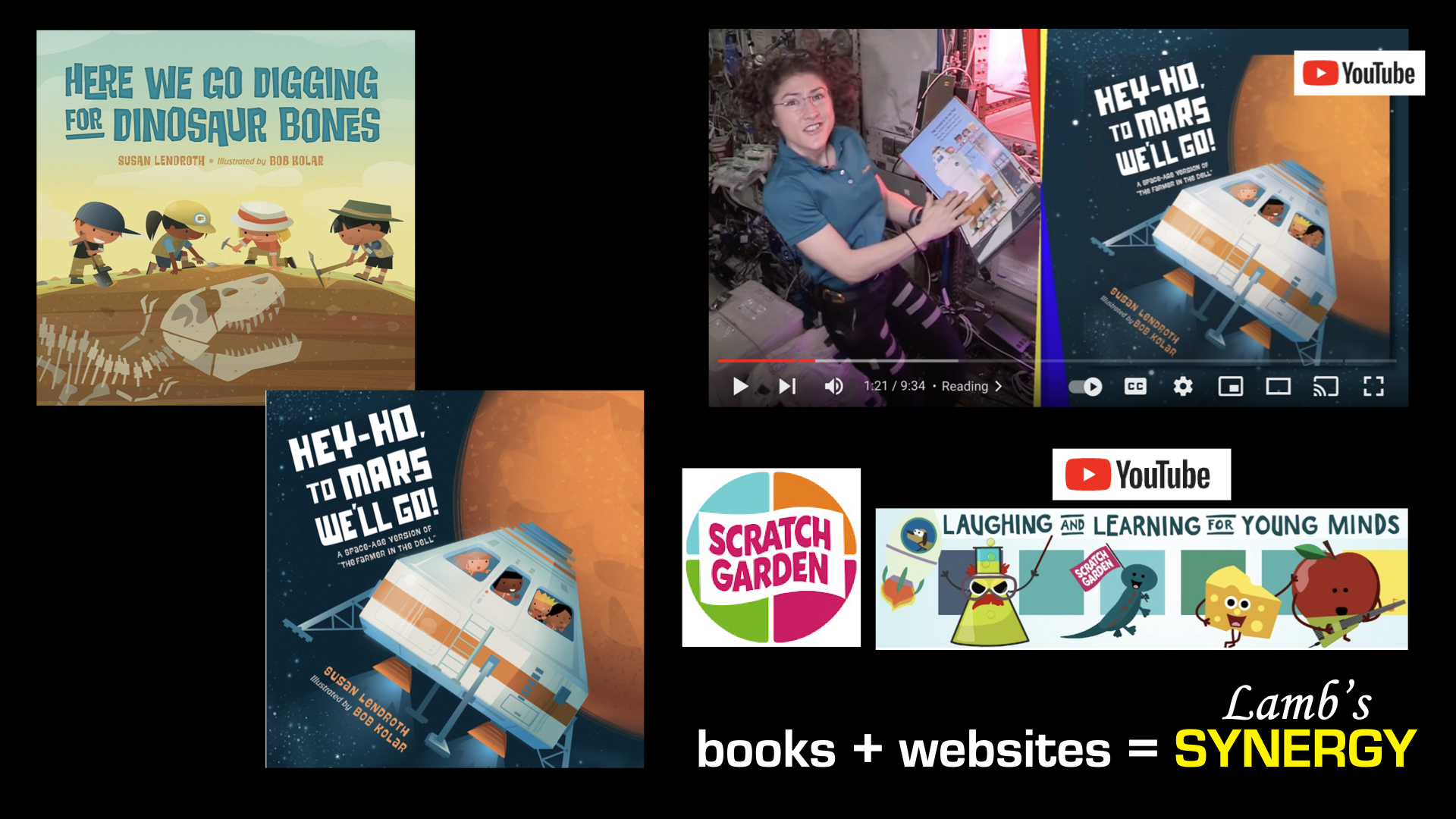
Author Susan Lendroth and illustrator Bob Kolar have teamed for a series of sing-a-long science picture books for young readers. Now available in board book format, HERE WE GO DIGGING FOR DINOSAUR BONES and HEY-HO, TO MARS WE’LL GO are the latest installments that began with OLD MANHATTAN HAS SOME FARMS.  These books are a fun way to introduce science occupations to young children using motivating and familiar tunes.


STORY TIME FROM SPACE is a YouTube channel that reads (and sings) picture books from the International Space Station. Listen to astronaut Christina Koch read Hey-Ho from space! To watch the video, go to https://youtu.be/7dtzMJipiuA.


SCRATCH GARDEN is a YouTube channel that specializes in fun and educational videos for children including STEM songs. To visit the channel, go to https://www.youtube.com/@ScratchGarden.


ARC courtesy of Charlesbridge, and imprint of Penguin Random House.


Monday, February 06, 2023

Synergy: Moon Phases


The Moon’s cycle is divided into four phases: new moon, first quarter, full moon, and last quarter. The four minor phases are waxing crescent, waxing gibbous, waning gibbous, and waning crescent. The lunar cycle changes gradually over approximately 29.53 days as the Moon’s position around Earth and Earth around the Sun shift.


Read the recently published children’s nonfiction picture book, then learn more at the websites:


THE MOON TONIGHT: OUR MOON’S JOURNEY AROUND EARTH written by Jung Chang-hoon and illustrated by Jang Ho tracks the moon in the night sky through its four phases: crescent, quarter, full, and new. This beautifully illustrated picture book combines space science with the experiences of a child enjoying the night sky and outdoor activities. The book concludes with additional facts. ARC courtesy of Blue Dot Kids Press, an imprint of Ingram Publisher Services.


MOON PHASES from TimeAndDate provides local information about moon phases.


To visit the website, go to https://www.timeanddate.com/moon/phases/.


MOON IN MOTION from NASA explains the positions of the Moon and the Sun. The project includes both still images and an interactive to demonstrate the moon phases.


To visit the web page, go to https://moon.nasa.gov/moon-in-motion/moon-phases/.


MOON PHASES from Crash Course is a short video discussing the names and causes of the Moon’s phases.


To watch the video, go to https://youtu.be/AQ5vty8f9Xc.


Monday, March 07, 2022

Synergy: Mars


Mars is the fourth planet from the Sun. Although several uncrewed spacecraft have explored this small planet, a human mission to Mars is likely in the next decade.

Read the recently published nonfiction book for youth then learn more at the website.


PACKING FOR MARS FOR KIDS by Mary Roach answers questions about space travel and life in space. This young readers adaptation contains all the humor and information found in the adult version while focusing on topics of interest to middle grade readers. From floating in space to toilet training, Roach shares both personal experiences and historical examples as she immerses readers in the practical aspects of a mission to Mars and beyond.


The MARS EXPLORATION PROGRAM website from NASA Science shares information and discoveries gathered from robotic orbiters, landers and mobile laboratories. Visitors can explore past, present, and future missions.


To visit the website, go to https://mars.nasa.gov/.


The HUMAN RESEARCH PROGRAM website from NASA explores the methods and technologies to support safe, productive human space travel. It includes links to useful resources about upcoming missions.


To visit the website, go to https://www.nasa.gov/hrp.


ARC courtesy of Norton Young Readers, an imprint of W. W. Norton.

Monday, March 02, 2020

Synergy: Drawing Aliens


People have been imagining what aliens might look like for generations. Are they little green men or otherworldly figures? No one knows, but children love to speculate.
Read the recently published children's book, then learn more at the website:
RALPH MASIELLO’S ALIEN DRAWING BOOK is part of Masiello’s popular drawing series that provides easy-to-following instructions for drawing. Whether sketching robots and flying saucers or the Multimouthed Martian, kids will have hours of fun with this engaging how-to picture book. The book concludes with suggested readings and websites.
Use NASA’S SPACE PLACE to bridge the gap between fantasy and reality. The website contains dozens of hands-on activities to explore space science topics.
NASA’s SpacePlace <https://spaceplace.nasa.gov/>
ARC courtesy of Charlesbridge.

Monday, October 28, 2019

Synergy: Moonwalks


The first moonwalk happened fifty years ago. Between 1969 and 1972 a dozen men walked on the moon during NASA Apollo missions.

Read the recently published children's picture book, then learn more at the website:

DARING DOZEN: THE TWELVE WHO WALKED ON THE MOON by Suzanne Slade takes picture book readers chronologically through a dozen Apollo moonwalks. Including both paintings and photographs, the book concludes with background information about each mission.

NASA’s The Apollo Missions website contains information about each mission along with images and videos.


ARC courtesy of Charlesbridge.

Saturday, February 02, 2019

Book Review: Countdown

COUNTDOWN by Suzanne Slade tells the true story of the moon landing.
Told through stunning illustrations and engaging free verse, this large picture book takes readers on a 2979 day journey from President John F. Kennedy’s announcement through the moon landing. Each of the nine chapters explore a different stage in the project. Thomas Gonzalez’s photo-quality images share a visual record, while the free verse draws readers into the engaging true story. The book concludes with background information, notes, a bibliography, quotations, and an index.
Librarians will find that this large picture book provides a unique way to experience this powerful story of engineering and human sacrifice. Pair it work biographies and other works of nonfiction along with the many NASA websites related to the moon project.
Published by Peachtree Publishers on September 1, 2018. ARC courtesy of the publisher.

Monday, August 06, 2018

Website Review: Solar System Exploration

SOLAR SYSTEM EXPLORATION from NASA Science is a real-time living encyclopedia of robotic exploration of the solar system.
Developed by NASA, the website provides accurate, up-to-date information about planets, moons, asteroids, comets, and other elements of our solar system along with a record of deep space exploration. Users can choose to learn about the solar system as a whole, planets, moons, or small bodies. A kids section provides activities for youth. Other sections feature news, resources, technology reports and other useful information. Of particular note are the interactives that engage learners with hands-on applications of real-world data.
Librarians will find this website provides an excellent introduction to the solar system. The easy-to-use interface is perfect for younger students and the option to explore in-depth is useful for older researchers.
To visit the project, go to https://solarsystem.nasa.gov/.

Saturday, July 21, 2018

Book Review: Astronaut Aquanaut

ASTRONAUT AQUANAUT by Jennifer Swanson explores the similarities and differences between deep space and deep sea exploration.
This visually appealing informational text includes an introduction and five chapters along with a people page, space-sea comparison, glossary, and index. Bright colored photographs, illustrations, and page layout add to the appeal.
Each chapter focuses on a different aspect of space or sea exploration. Readers are invited to read facts, conduct experiments, try activities, and explore the lives of scientists.
Librarians will find this book provides an unusual and fascinating way to think about deep space and deep sea exploration. Weave the title into the science curriculum and work with science teachers to use the space-sea comparison as the basis of class projects. Create a display with books about both environments placing this title in the center.
Published on April 1, 2018 by National Geographic. ARC courtesy of the publisher.

Monday, May 28, 2018

Website Review: Storytime from Space

STORYTIME FROM SPACE is a a project connecting children with astronauts for reading and science activities.
This nonprofit educational project provides cross-content curriculum materials related to space science. The website contains science demonstrations and a video library. Astronauts at the International Space Station have recorded themselves reading children’s books about space.
Librarians will find this website a motivating way to engage reluctant readers. The videos are an excellent way to help children connect the science they learn in the classroom with the real-word of space travel.
To visit the website, go to http://storytimefromspace.com/.

Friday, December 22, 2017

Website Review: Cassini: The Grand Finale

CASSINI: THE GRAND FINALE explores the two decade mission of NASA’s Cassini spacecraft.
This comprehensive website provides data and information about the journey of the Cassini mission to Saturn. Sections of the website include the journey, science, mission, galleries, news, and resources. The journey section is divided into a timelines, the spacecraft, behind the scenes, and the grand finale. The science area explores the discoveries found during the mission. Audio, video, images, and more can be found in the gallery. Use the resources section for teaching materials.
Librarians will find that science teachers and their students will find this website useful in tracing a NASA mission from beginning to end. Involve students in comparing this mission with other NASA endeavors.
To visit the website, go to https://saturn.jpl.nasa.gov/.

Wednesday, December 28, 2016

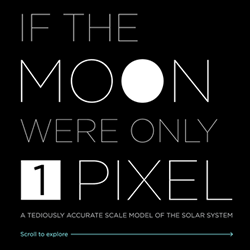
Website Review: If the Moon Were Only 1 Pixel

IF THE MOON WERE ONLY 1 PIXEL visualizes the scale of the solar system.
Using a series of slides, this fascinating model of solar system uses the scale of 1 pixel equal to 3474.8 kilometers (or the distance from New York to Las Vegas). As users scroll from the sun through the planets and moons in our solar system, interesting statements and facts appear on the screen.
A button is used to show how quickly light travels. An option is provided to change the scale to amounts such as miles, light minutes, buses, and blue whales. Users can also jump to specific objects in the solar system.
Librarians will find this web-based project to be a fun way to explore scale in both math and science. Use it in a display featuring books about scale and the solar system.

Wednesday, October 19, 2016

Website Review: The Last Mission to the Moon

THE LAST MISSION TO THE MOON immerses young people in a real-time journey through the Apollo 17 mission to the moon.
This comprehensive website includes over 300 hours of audio, 22 hours of video, and 4,200 photos related to the mission. Users can either start the experience at T-minus one minute or join the mission in progress.
Users are presented with a screen that includes a control panel including video, audio, images, a transcript, a guided tour, commentary, and more. Along the way, the experience can be paused, photos can be selected, or other choices can be made. The mission can be tracked, fast-forwarded, and rewound using the interactive timeline.
Librarians will find this website popular with fans of the space program. Use this real-time experience as an example of the value of primary sources in information inquiry. Weave the website into a display featuring books about the history of moon exploration.
To use the website, go to http://apollo17.org/.

Monday, September 12, 2016

Technology Review: NASA's Eyes

NASA’S EYES is a website and apps that can be used to explore Earth, the solar system, and the universe along with the spacecraft used for exploration.
While some of the interactives are browser-based, others require the NASA’s Eyes app.
Interactive visualizations include Juno, Eyes on the Earth, Eyes on the Solar System, and Eyes on Exoplanets. Solar system tours are also available.
The Events on Earth section explores recent events on our own planet including dust storms, fires, and hurricanes using satellite imagery.
DSN Now is a live web app that allows users to see which spacecrafts are currently active.
Finally, Experience Curiosity is a WebGL experience that allows users to learn about the Curiosity rover as it explores Mars.
Librarians will find this website a great way to get young people excited about space and space exploration. Use the website and apps to jumpstart research projects.
To visit the website, go to http://eyes.nasa.gov/

Thursday, September 01, 2016

Website Review: Total Solar Eclipse

TOTAL SOLAR ECLIPSE from Exploratorium provides a gathering place for news, information, and resources related to total solar eclipses.
The “About Eclipses” section includes nine short videos defining a solar eclipse and demonstrating what happens and how to view one. It also contains links to informational pages containing diagrams, maps, and other useful scientific facts.
The “Our Expedition” section takes users through the process of participating in a solar eclipse including live broadcasts, Tweets, blog entries, and suggestions for hosting an event.
The “Past Eclipses” section includes information about past eclipse events and webcasts back to 1998.
Librarians and science teachers will want to participate in the August 2017 event that will be appearing in the skies above the USA. The website will be updated as the event draws nearer. Create a bulletin board showing a map of the 2017 event and information about eclipses. Include books and other information to generate interest in this unusual event.
To learn more, go to the website at http://www.exploratorium.edu/eclipse.

Saturday, August 13, 2016

Website Review: Sizing Up the Universe

SIZING UP THE UNIVERSE from the Smithsonian Institution is web-based interactive that helps students make comparisons between objects found in outer space.
Users are presented with objects found in space and explore the relative sizes and distances. Familiar objects such as beachballs and cookies help students visualize relationships. Google maps allows students to make place-based connections and comparisons.
Students are taken step-by-step through the universe starting with the Earth and Moon. Users are kept active by selecting objects and making decisions. Concise, informative feedback is provided at each stage. Short videos provide engaging information.
Librarians will find this website to be a useful way to help students visualize sizes in space. Both science and math teachers will find practical applications for this online interactive. Pair the website with books and videos exploring relative size and distance. Design a learning station with hands-on opportunities to size and distance experiments.

Wednesday, August 03, 2016

Technology Review: Be a Martian

NASA’s BE A MARTIAN app and websites immerses students in experiences and information related to Mars missions.
The app is divided into sections exploring a wide range of tools, information, and activities.
The Featured section contains Mars posters, quick facts, and cards.
The See section focuses on visual representations of Mars including raw images from Curiosity, Mars as art, Mars photographs, short videos, and animations.
The Learn section explores Mars missions, Curiosity’s journey, news, videos, and information.
The Ask section allows youth to ask a question of NASA scientist Dr. Phil Christensen when he’s available.
The More section connects with NASA websites. The Be A Martian website extends the app experience and the Mars Exploration website contains news, information, and multimedia resources focusing on the Mars program.
Between the app and the websites, librarians will find endless resources exploring the Mars program for all grade levels. Consider developing a display that incorporates a tablet with the app, a laptop with the website, books, and focused, hands-on activities.
To download the app, go to https://itunes.apple.com/…/app/nasa-be-a-martian/id543704769.
To visit the app website, go to http://beamartian.jpl.nasa.gov/welcome.
To visit NASA’s Mars Exploration website, go to http://mars.jpl.nasa.gov/.

Friday, July 22, 2016

Website Review: NASA WAVELENGTH

NASA WAVELENGTH provides a full spectrum of resources for science education.
Sponsored by NASA, this website provides access to a digital collection of Earth and space science resources for all grade levels. Specifically, they focus on helping students develop an understanding of our planet Earth, our Sun and solar system, and the universe.
The Science Data and Images section is divided into introductory, intermediate, and advanced resources. The page shares key online collections and descriptions of these resources.
The Strandmaps page links to interactive concept maps on specific science and math topics in the areas of the physical setting, the nature of science, the living environment, the designed world, habits of mind, the nature of technology, and common themes. Each map introduces related concepts, how the concepts are aligned to benchmarks and standards, and links to resources.
The blog provides news, updated information, and resources of interest to educators in a wide range of topics such as astronomy, astrophysics, citizen science, data, and others.
A search tool can be used to find resources by key word and audience. Materials can also be explored by grade level. Finally, links are provided to key multimedia resources including apps, videos, and images.
Librarians will find these resources to be popular with science teachers. Work with teachers to align the materials with the curriculum.
To visit the website, go to http://nasawavelength.org/.

Friday, May 20, 2016

Series Review: Explore My World

The EXPLORE MY WORLD series by Becky Baines helps young children learn about the world around them.
Featuring a wide range of topics, each informational book contains facts and reflective questions to get young children thinking.
DOLPHINS provides a look at the world of dolphins including their characters, habitat, life cycle, and what they eat. It defines key concepts, provides a labeled diagram, and introduces the idea of marine mammals.
PLANETS defines the concept of planet and provides a map of planets. Using age-appropriate language and examples, the book helps children better understand Earth and how other planets are alike and different from Earth.
Librarians will find this series to be an excellent way to introduce informational reading to young children. With many books in the series to choose from, ask students to explore a book of interest and share their questions. Use the books as part of a buddy reading program with older children who might share their interest in science topics.
Published by National Geographic Kids on March 8, 2016. ARC courtesy of the publisher.