Monday, March 20, 2023

Synergy: Garbage


GARBAGE is material discarded by humans because it’s no longer of use. Sometimes called trash, rubbish, or waste, these objects include organic matter such as food scraps, dry goods like boxes and bottles, and consumer products made of plastic, wood, metal, glass or cloth. Garbology is the study of modern trash.


Read the recently published narrative nonfiction for middle grades, then learn more at the websites:


TOTAL GARBAGE: A MESSY DIVE INTO TRASH, WASTE, AND OUR WORLD written by Rebecca Donnelly and illustrated by John Hendrix traces the history of the trash and waste generated by humans. In addition, readers learn about the different types of garbage, how it’s managed, and what individuals can do to reduce their impact on the Earth. ARC courtesy of Henry Holt and Co., an imprint of Macmillan.


HISTORY OF GARBAGE from SWA provides a brief timeline of trash.


To read the article, go to https://swa.org/DocumentCenter/View/277/History-of-Garbage-PDF.


GARBOLOGY from BBC is an article exploring patterns in people’s waste.


To read the article, go to https://www.bbc.com/future/article/20220429-garbology-how-to-spot-patterns-in-peoples-waste.


GARBOLOGY from UW video shares the work of garbologists at the University of Washington.


To view the video, go to https://youtu.be/1C2aQuK_LD4.


Monday, March 13, 2023

Synergy: Birka Viking Warrior


BIRKA VIKING WARRIOR was a 10th century professional woman soldier. First discovered in the 1870s, the bones were originally thought to be male. Recent DNA research confirmed that the skeleton was female. Artifacts in the grave indicate that the warrior woman was likely known for her battle strategy.


Read the recently published nonfiction book for young adults, then learn more at the websites:


THE BONES OF BIRKA by C.M. Surrisi traces the story of a 10th century Viking warrior women from her discovery in the 19th century to Dr. Charlotte Hedenstierna-Johnson’s recent DNA analysis. Of particular note is how the book challenges traditional gender roles in ancient societies and traditional research bias. ARC courtesy of Chicago Review Press.


An article in the AMERICAN JOURNAL OF PHYSICAL ANTHROPOLOGY provides details of the research.


To read the article, go to http://uu.diva-portal.org/smash/record.jsf?pid=diva2%3A1160189&dswid=9775


An article in SMITHSONIAN MAGAZINE discusses the latest evidence that Birka was a woman Viking warrior.


To read the article, go to https://www.smithsonianmag.com/smart-news/researchers-reaffirm-famed-ancient-viking-warrior-was-biologically-female-180971541/


An article in LIVE SCIENCE also discusses the Viking warrior woman.


To read the article, go to https://www.livescience.com/64816-woman-viking-warrior-burial.html


Monday, March 06, 2023

Synergy: Scopes Monkey Trial


The SCOPES MONKEY TRIAL challenged the Butler Act prohibiting the teaching of human evolution in schools. Science teacher John Scopes (1900-1970) agreed to become the defendant in the test case pitting science against religion. He was found guilty and the act remained in place until 1967.


Read the recently published nonfiction book for middle grades, then learn more at the websites:


THE MONKEY TRIAL: JOHN SCOPES AND THE BATTLE OVER TEACHING EVOLUTION by Anita Sanchez is a well-researched, nonfiction book for middle grades examining what became known as the Scopes Monkey Trial. Weaving primary sources with engaging narrative, Sanchez focuses on the teacher who stood up for the rights of students to learn. The book stresses that the conflict between science and religion continues today. ARC courtesy of Clarion Books, an imprint of HarperCollins.


JOHN SCOPES is a short article from PBS about the teacher and trial.


To read the article, go to https://www.pbs.org/wgbh/americanexperience/features/monkeytrial-john-scopes/.


THE SCOPES MONKEY TRIAL from In Search of History weaves photos and historical footage into a video about the trial.


To watch the video, go to https://youtu.be/bdD9vi4koUw.


The SCOPE “MONKEY” TRIAL from the State bar of Georgia shares an animated video about the famous trial.


To watch the video, go to https://youtu.be/YdqnwRwbb4Q.


Wednesday, March 01, 2023

Timely Take-aways for life-long Learners: Modern European History: A Fresh Look


Several new works of nonfiction provide fresh insights into early modern and modern European history. Beyond the violence and wars, these books examine the period through archaeology, political actions, and the roles of women.


Bosworth: The Archaeology of the Battlefield
Richard Mackinder, Feb 2022, Pen and Sword Military, Casemate Publishers
Themes: History, Military

Richard Mackinder uses the latest archaeological research to take readers step-by-step through the Battle of Bosworth (1485) that began the early modern era.

Take-aways: Use this fascinating work to help youth better understanding the role of physical evidence and archaeology in understanding key historical events.


William of Orange and the Fight for the Crown of England: The Glorious Revolution
Brian Best, Oct 2021, Frontline Books, Casemate Publishers
Themes: Biography, History, Military

Known as the Glorious Revolution, Protestant William of Orange and his troops ousted Catholic King James. Brian Best takes readers through the Stuart dynasty from 1660 to 1714 on an exploration of the key acts passed by Parliament and the major religious conflicts of the period along with the life of King William III of England, Scotland, and Ireland.

Take-aways: Use this work of nonfiction to talk with youth about how conflicts were settled not only by violence, but also through Acts of Parliament.


The House of Orange in Revolution and War: An European History, 1772-1890
Jeroen Koch, Dik Van Der Meulen, Jeroen Van Zenten, May 2022, Reaktion Books, University of Chicago Press
Themes: History, Europe

This sweeping history of the House of Orange-Nassau takes readers from the 18th century into the 20th century. Exploring three Dutch Kings, this fast-paced narrative examines the transnational impact of this period.

Take-aways: Use this book to review the key people, places, and events of European history through the lens of the House of Orange-Nassau.


When Women Ruled the World: Making the Renaissance in Europe
Maureen Quilligan, Dec 2022, Liveright, an imprint of W. W. Norton
Themes: History, Europe, Tudor & Elizabethan Era (1485-1603)

Quilligan’s engaging work of nonfiction demonstrates how powerful women challenged tradition by creating strategic alliances and assuming political authority. Through gift giving and political ingenuity, four Queens figured out a way to flourish in a male dominated world.

Take-aways: Use this book as an outstanding example of revisionist history that seeks to demonstrate how creative, intelligent women impacted the European monarchy.


The Tudors in Love:Passion and Politics in the Age of England’s Most Famous Dynasty
Sarah Gristwood, Dec 2022, St. Martin’s Press, an imprint of Macmillan
Themes: History, Europe, Great Britain, Tudor & Elizabethan Era (1485-1603)

Romantic courtly love played a key role in politics and international diplomacy during the Tudor dynasty. Sarah Gristwood takes readers through the drama and obsessions that shaped the era.

Take-aways: Teens love drama. Use Gristwood’s captivating history to bring this period alive for students.


Whether helping educators keep up-to-date in their subject-areas, promoting student reading in the content-areas, or simply encouraging nonfiction leisure reading, teacher librarians need to be aware of the best new titles across the curriculum and how to activate life-long learning. - Annette Lamb


Monday, February 27, 2023

Synergy: Eggs


EGGS are roundish objects usually containing a developing embryo. Laid by female creatures such as birds, reptiles, fish, or invertebrates, eggs may be covered with a hard or leathery shell. When the creature is ready to survive on its own, it hatches.


Read the recently published nonfiction picture book for children, then learn more at the websites:


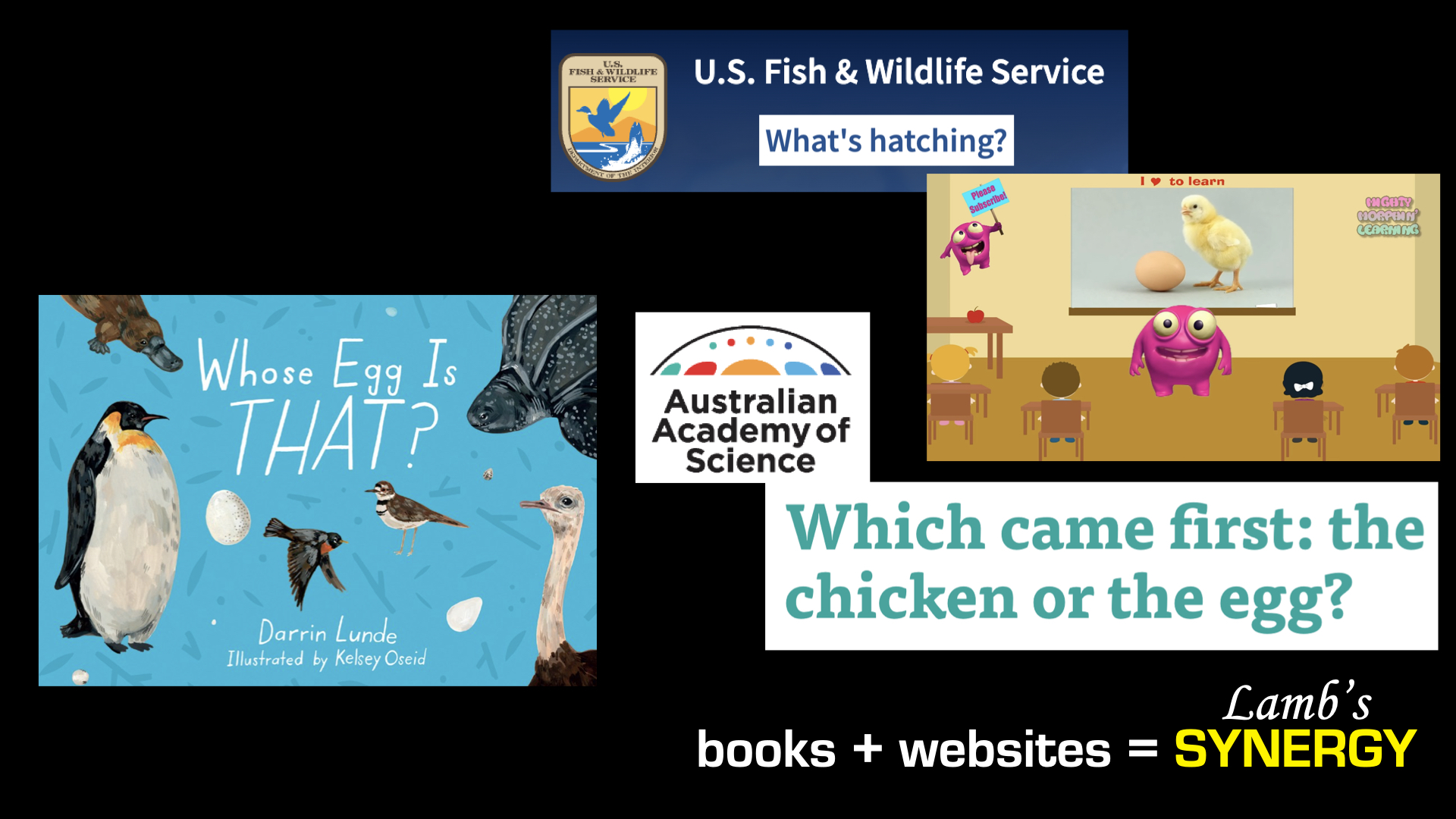
WHOSE EGG IS THAT? written by Darrin Lunde and illustrated by Kelsey Oseid is a picture book for young learners. Part of the Whose is That? Series, the book provides visual hints to spark inquiries into animals, eggs and their habitats. The simple text and illustrations will appeal to young learners and focus their attention on the seven interactive guessing games. ARC courtesy of Charlesbridge, and imprint of Penguin Random House.


KIDS LEARN ABOUT ANIMALS THAT HATCH is a short video with a game component that reviews animals that hatch.


To watch the video, go to https://youtu.be/vq8-wqGYve0.


FROM EGG TO ANIMAL is a short, easy to read article from Time for Kids exploring animals that hatch from eggs.


To read the article, go to https://www.timeforkids.com/k1/from-egg-to-animal/?rl=en-650.


AT RISK ANIMALS AND THEIR UNUSUAL EGGS is an article from the U.S. Fish & Wildlife Service about different types of eggs.


To read the article, go to https://www.fws.gov/story/risk-animals-and-their-unusual-eggs.


WHICH CAME FIRST addresses the classic riddle about eggs and chickens.


To read the article, go to https://www.science.org.au/curious/earth-environment/which-came-first-chicken-or-egg.


Monday, February 20, 2023

Synergy: The Holocaust


The Holocaust was the systematic murder of millions of Jews during World War II. This genocide occurred between 1941 and 1945 across German-occupied Europe. Although primarily focused on the Jewish population, mass-killings of other relatively small, targeted populations also occurred during the Holocaust era.


Read the three recently published books for youth, then learn more at the websites:


THE BOY WHO FOLLOWED HIS FATHER INTO AUSCHWITZ by Jeremy Dronfield is a work of nonfiction narrative adapted for young readers. Based on primary resources including a diary and interviews, readers learn about the challenges faced by two brothers who experienced the Holocaust very differently. ARC courtesy of Quill Tree Books, an imprint of HarperCollins.


HARBORING HOPE by Susan Hood tells the true story of Henny Sinding who saved Danish Jews during the Holocaust. Written for middle grade and young adult readers, the nonfiction novel-in-verse shares the essential role of resistance fighters during Germany’s occupation of Denmark. The book includes primary sources, photographs, and additional information to extend the experience. ARC courtesy of HarperCollins.


QUESTIONS I AM ASKED ABOUT THE HOLOCAUST by Hedi Fried is a young reader’s edition of an autobiographical text for adults. The book is organized around dozens of questions that provide young people with unique insights into the challenges this Auschwtiz survivor faced during and after the Holocaust. The book concludes with background information and context. ARC courtesy of Scribble US, an imprint of Ingram Publisher Services.


The HOLOCAUST ENCYCLOPEDIA is a reference database from the United States Holocaust Memorial Museum. This searchable resource provides access to thousands of articles and primary source documents.


To search the database, go to https://encyclopedia.ushmm.org/.


YAD VASHEM: The World Holocaust Remembrance Center is a website sharing information about the Holocaust, digital collections, and a database of victims.


To explore the website, go to https://www.yadvashem.org/.


Monday, February 13, 2023

Synergy: Abraham Lincoln


ABRAHAM LINCOLN (1809-1865) served as the 16th president of the United States. Leading the nation during the American Civil War, he abolished slavery, preserved the nation, and modernized the economy. He was assassinated just days before the end of the war.


Read the recently published work of nonfiction for middle grades, then learn more at the websites:


MR. LINCOLN SITS FOR HIS PORTRAIT by Leonard S. Marcus uses a historical photograph to jumpstart a discussion of Abraham Lincoln and a day in this life. The author’s use of historical photos, artifacts, and timelines along with the short text blocks will draw the attention of young readers. In addition, youth will enjoy the way Lincoln’s son Tad is woven into the narrative. This book provides an engaging alternative to the many traditional Lincoln biographies already available in the library. ARC courtesy of Farrar, Straus and Giroux, an imprint of Macmillan.


ABRAHAM LINCOLN is an article from National Geographic Kids providing an introduction to Abraham Lincoln.


To read the article, go to https://kids.nationalgeographic.com/history/article/abraham-lincoln.


THE MASK OF LINCOLN is an online exhibit from the National Portrait Gallery sharing photographs of Lincoln during his presidency.


To explore the exhibit, go to https://npg.si.edu/exhibit/lincoln/.


Monday, February 06, 2023

Synergy: Moon Phases


The Moon’s cycle is divided into four phases: new moon, first quarter, full moon, and last quarter. The four minor phases are waxing crescent, waxing gibbous, waning gibbous, and waning crescent. The lunar cycle changes gradually over approximately 29.53 days as the Moon’s position around Earth and Earth around the Sun shift.


Read the recently published children’s nonfiction picture book, then learn more at the websites:


THE MOON TONIGHT: OUR MOON’S JOURNEY AROUND EARTH written by Jung Chang-hoon and illustrated by Jang Ho tracks the moon in the night sky through its four phases: crescent, quarter, full, and new. This beautifully illustrated picture book combines space science with the experiences of a child enjoying the night sky and outdoor activities. The book concludes with additional facts. ARC courtesy of Blue Dot Kids Press, an imprint of Ingram Publisher Services.


MOON PHASES from TimeAndDate provides local information about moon phases.


To visit the website, go to https://www.timeanddate.com/moon/phases/.


MOON IN MOTION from NASA explains the positions of the Moon and the Sun. The project includes both still images and an interactive to demonstrate the moon phases.


To visit the web page, go to https://moon.nasa.gov/moon-in-motion/moon-phases/.


MOON PHASES from Crash Course is a short video discussing the names and causes of the Moon’s phases.


To watch the video, go to https://youtu.be/AQ5vty8f9Xc.


Wednesday, February 01, 2023

Timely Take-aways for life-long Learners: Strong Women Around the World


From a planetary scientist to a pirate’s wife, several new autobiographies and biographies explore the lives of lesser-known women through history. Whether using her position as first lady to support educational projects or solving crimes on the high seas, these nontraditional women left powerful legacies.


A Portrait of the Scientist as a Young Woman: A Memoir
Lindy Elkins-Tanton, May 2022, William Morrow, HarperCollins
Themes: Memoir, Science, Women

Elkins-Tanton overcame a traumatic childhood and ovarian cancer to become the principal investigator on a major space exploration project. Her engaging story shares personal connections with science and how these experiences lead her to find meaning in life.

Take-aways: Teachers will find useful examples that demonstrate how to nurture a passion for science in students, particularly young women.


A Woman of Adventure:
The Life and Times of First Lady Lou Henry Hoover
Annette B. Dunlap, June 2022, Potomac Books and Longleaf Services
Themes: Biography, First Ladies, Women

While supporting her husband’s political career and the needs of her family, Lou Henry Hoover was still able to promote educational opportunities for women. This engaging biography shares the fascinating life and powerful legacy of this less-known first lady.

Take-aways: Students are likely familiar with first ladies such as Eleanor Roosevelt. Use this biography to demonstrate the achievements of first lady Lou Henry Hoover.


Woman, Captain, Rebel:
The Extraordinary True Story of a Daring Icelandic Sea Captain
Margaret Willson, January 2023, Sourcebooks
Themes: Biography, Maritime History, Women

This fast-paced, well-researched biography tells the story of Captain Thurídur Einarsdóttir, a woman who fought for human rights as Iceland’s most famous female sea captain. Whether solving a robbery or challenging social norms, this powerful woman fought for underrepresented Icelanders.

Take-aways: Women’s stories are underrepresented in the world history curriculum. Feature the story of Captain Thurídur Einarsdóttir to demonstrate the ongoing struggles of women in nontraditional roles.


The Pirate’s Wife: The Remarkable True Story of Sarah Kidd
Daphne Palmer Geanacopoulos, Dec 2022, Hanover Square Press, HarperCollins
Themes: Biography, Maritime History, Women

During the Golden Age of Piracy, socialite turned legendary accomplice Sarah Kidd fought behind the scenes in support of her infamous pirate husband. This work of narrative nonfiction connects this resourceful woman to the larger story of pirate wives.

Take-aways: Traditional pirate stories overlook the role wives played in support of their swashbuckling husbands. Weave this example into the broader context of the Golden Age of Piracy.


In Search of Amrit Kaur: A Lost Princess and Her Vanished World
Livia Manera Sambuy, Mar 2023, Farrar, Straus and Giroux, Macmillan
Themes: Biography, World History, Women

Livia Manera Sambuy traces the forgotten story of H. H. Amrit Kaur of Mandi, a woman who left her family for personal freedom and spoke out for women’s rights.

Take-aways: Teachers are always looking for less-known stories and perspectives.


Whether helping educators keep up-to-date in their subject-areas, promoting student reading in the content-areas, or simply encouraging nonfiction leisure reading, teacher librarians need to be aware of the best new titles across the curriculum and how to activate life-long learning. - Annette Lamb


Monday, January 30, 2023

Synergy: Xenophobia


Xenophobia is prejudice against people from countries other than their own. From dislike to persecution, immigrants often deal with fear and hatred. These people may be identified as strange or foreign and become the target of racism and political persecution.


Read the recently published work of nonfiction for young adults, then learn more at the website:


DOOMED: SACCO, VANZETTI & THE END OF THE AMERICAN DREAM by John Florio and Ouisie Shapiro tells the story of Italian immigrants wrongly executed for murder. Divided into three parts, the authors begins with America (1908-1920), continues with the Trial (1921), and concludes with the Posttrial (1921-1927). During the 1920’s, prejudice against immigrants was common throughout America. This fast-paced nonfiction narrative reflects issues of xenophobia still in the headlines today. Photographs and other primary sources are woven into the narrative and a useful list of sources is provided. ARC courtesy of Roaring Brook Press, an imprint of Macmillan.


SACCO AND VANZETTI COMMEMORATION SOCIETY is a website designed to preserve the memory of Sacco and Vanzetti along with their struggles.


To explore the website, go to http://www.saccoandvanzetti.org/.


SACCO & VANZETTI: MURDERS OR SCAPEGOATS? is a video from The 1920s Channel that provides an overview of the story.


To view the video, to go https://youtu.be/5aBLYrZE3xM.


SACCO & VANZETTI is a Part 1 of a documentary that includes interviews with researchers and historians about the lives of Nicola Sacco and Bartolomeo Vanzetti.


To view the video, go to https://youtu.be/wkKsfOklrbA.


Monday, January 23, 2023

Synergy: Indigenous Wisdom


INDIGENOUS WISDOM is the knowledge, skills, and philosophies preserved by the Native people of Earth. Handed down over thousands of generations, this wisdom places emphasis on the interconnectedness of all things in nature.


Read the recently published young adult adaptation of a popular nonfiction work for adults, then learn more at the websites:


BRAIDING SWEETGRASS FOR YOUNG ADULTS by Robin Wall Kimmerer shares indigenous wisdom, scientific knowledge and the teachings of plants. As an adaptation of the popular adult title, Monique Gray Smith effectively speaks to young people while maintaining Kimmerer’s message. The text uses meeting, planning, tending, picking, braiding and burning sweetgrass as a theme that weaves together anecdotes, traditional stories, engaging facts, and global understandings to introduce students to the idea that all living things are connected. Sidebars, reflective questions, and illustrations contribute to the appeal for young adult audiences. ARC courtesy of Zest Books, an imprint of Learner Publishing Group.


I MUST RETURN THE GIFT by Phoebe Lyn Pinkner connects excerpts from Braiding Sweetgrass with nature video clips to create a compelling short film.


To watch the short film, go to https://vimeo.com/639233670.


KITCHEN TABLE V2 is a video sharing the process of adapting Braiding Sweetgrass for young people.


To watch the video, go to https://youtu.be/Jpq8ruxpqew.


Monday, January 16, 2023

Synergy: Graph


A GRAPH is a diagram visualizing the relationship between variables on a pair of axes. Examples of charts and graphs include bar graphs, line graphs, area graphs, XY graphs, diagrams, grids, bar charts, and pie charts.


Involve children in collecting data and creating their own charts and graphs.


Read the recently published children’s picture book, then learn more at the website:


SHOW AND TELL! written by Stuart J. Murphy and illustrated by Teresa Bellon introduces the concepts of infographics, graphs, and charts. This nonfiction picture book brings math alive through interesting text and useful visuals. From counting burps and pets to visualizing amusement park rides, readers will enjoy the real-world examples. ARC courtesy of Charlesbridge, an imprint of Penguin Random House.


CREATE A GRAPH from the National Center for Education Statistics introduces children to graphs and charts and provides tools for creating their own. A graph tutorial is available to assist young learners.


To visit the website, go to https://nces.ed.gov/nceskids/createagraph/.


Monday, January 09, 2023

Synergy: Vegetarian


A VEGETARIAN is a person who chooses not to eat meat such as fish, beef, pork, and chicken. Some vegetarians don’t eat animal products such as dairy or eggs. The term is also used to describe meals or places that exclude animal products.


Working in pairs, ask children to create two menus for the day, one traditional and one vegetarian.


Read the recently published informational children’s picture book, then learn more at the websites:


BAKE, MAKE & LEARN TO COOK VEGETARIAN written by David Atherton and illustrated by Alice Bowsher features healthy, green recipes for children. After an introduction, readers explore recipes for  meals, snacks, sweets, and showstoppers. Each recipe includes an overview, ingredients, and step-by-step instructions with useful visuals and useful text. Most of the ingredients are commonly found in grocery stories. ARC courtesy of Candlewick Press.


VEGETARIANISM from Britannica for Kids introduces the concept, diet, and history.


To read the article, go to https://kids.britannica.com/kids/article/vegetarianism/609722.


WHAT IS A VEGETARIAN? is a page from the Vegetarian Society that explains the basics of a vegetarian diet.


To read the article, go to https://vegsoc.org/info-hub/definition/.


VEGETARIANISM: THE BASIC FACTS is short article discussing the reasons why people choose a vegetarian diet.


To read the article, go to https://www.eatright.org/food/nutrition/vegetarian-and-special-diets/vegetarianism-the-basic-facts.


Monday, January 02, 2023

Synergy: Invasive Species


INVASIVE SPECIES are living things that are not native to a particular location. They often thrive in their introduced area pushing out other flora and fauna. These out-of-place plants and animals cause harm to the environment and economy causing a wide range of problems.


Ask students to learn about an invasive species and debate possible solutions to the problem.


Read the recently published graphic nonfiction for youth, then learn more at the websites:


BEWARE THE BURMESE PYTHONS written by Etta Kaner with illustrations by Phil Nicholls uses a comic format to share information about invasive animal species. This attractive work of graphic nonfiction successfully introduces youth to the destruction of invasive animal species and the question of how to address the problem. Each two-page, newspaper-type spread introduces a different animal and its impact. The book concludes with a glossary, sources, and additional information. ARC courtesy of Kids Can Press, an imprint of Hachette Book Group.


WHAT ARE INVASIVE SPECIES? from the National Part Service provides a short video and information about native species, non-native species, and invasive species.


To learn more, go to https://www.nps.gov/subjects/invasive/what-are-invasive-species.htm.


The NATIONAL INVASIVE SPECIES INFORMATION CENTER at the U.S. Department of Agriculture provides information about invasive species and the US government response to these plants, animals, and other living organisms.


To visit the website, go to https://www.invasivespeciesinfo.gov/what-are-invasive-species.


INVASIVE SPECIES from National Geographic provides an introduction and examples of invasive species and their impact.


To read the article, go to https://education.nationalgeographic.org/resource/invasive-species.


Sunday, January 01, 2023

Timely Take-aways for Life-Long Learning: History of Place

Whether exploring the history of remote mountain regions or telling the story of a city through its people, these new works of nonfiction explore how five places around the world evolved over time.


Beaver River Country: An Adirondack History
Edward I. Pitts, June 2022, Syracuse University Press, Longleaf
Themes: History, Adirondacks, United States

Pitts explores the history of the remote northeastern United States known as the western Adirondacks. From indigenous people to early settlers and seasonal visitors, Pitts shares how this wild area was preserved and continues to survive.

Take-aways: Use this book to jumpstart an exploration of your own region’s rural areas. Think about how local history such as photos, key historical events, and interesting people can bring your area live for students.


France: An Adventure History
Graham Robb, July 2022, W.W. Norton & Company, and imprint of W.W. Norton
Themes: History, Europe, France

Balancing fascinating historical information with humorous anecdotes, Robb’s amazing narrative reflects decades of research and exploration of France’s urban and rural areas. 

Take-aways: Use this book as an example of the connection between history and travel. Use the author’s adventures to encourage students to think about places they’d like to visit and explore in-depth.


España : A Brief History of Spain 
Giles Tremlett, Sept 2022, Bloomsbury Publishing, an imprint of Macmillan
Themes: History, Europe, Western

From prehistoric times to today, readers explore the geographic, cultural, and political history of Spain along with its relationship with people and lands nearby. Stunning photographs and illustrations bring the place and international history to life.

Take-aways: Educators will find the book’s approach useful as they think about interesting ways to present international history.


The New Yorkers: 31 Remarkable People, 400 Years, and the the Untold Biography of the World’s Greatest City
Sam Roberts, Oct 2022, Bloomsbury Publishing, an imprint of Macmillan
Themes: History, Biography, New York, United States

The story of New York is told through the lives of lesser-known individuals who impacted the cultural landscape of the famous city.

Take-aways: Think about how this book uses individual lives to tell the city’s story. Ask youth to use a biography-focused approach to telling the story of another city. 


Himalaya: Exploring the Roof of the World
John Keay, Nov 2022, Bloomsbury Publishing, an imprint of Macmillan
Themes: History, Asia, Central Asia

Keay explores the unique historical, social, geographic, and environmental aspects of Himalaya. Told thought fascinating anecdotes, readers explore the unique features of this endangered area of the world.

Take-aways: Of particular note is how the author connects the history of the Himalaya to the consequences of climate change. Think about how this approach could be applied in teaching about other areas of the world.


Whether helping educators keep up-to-date in their subject-areas, promoting student reading in the content-areas, or simply encouraging nonfiction leisure reading, teacher librarians need to be aware of the best new titles across the curriculum and how to activate life-long learning. - Annette Lamb

Monday, December 26, 2022

Synergy: Butterflies


BUTTERFLIES are insects with a four-stage life cycle. Part of the Lepidoptera order, some butterflies like the painted lady migrate over long distances. Butterfly gardens contain plants that provide nectar for adult butterflies and a habitat that nurtures the stages of their development.


Encourage students to learn about the butterflies common to your area, then involve them in designing a butterfly garden to attract these creatures.


Read the recently published informational children’s picture book, then learn more at the websites:


THE STORY OF A BUTTERFLY by Margaret Rose Reed explores the life cycle and habitat of the Painted Lady butterfly. Two friends take a field trip to a butterfly garden along with their class and decide to make their own community garden. The storybook approach introduces young readers to the science of butterflies along with the joy of learning. The picture book concludes with additional information about the Painted Lady butterfly and a comparison of moths and butterflies. ARC courtesy of Sourcebooks eXplore.


BUTTERFLIES AND MOTHS OF NORTH AMERICA is a database providing information about the wide range of Lepidoptera found in North America. Readers are encouraged to participate in their online project.


To search the database, go to https://www.butterfliesandmoths.org.

To read about the Painted Lady, go to https://www.butterfliesandmoths.org/species/Vanessa-cardui.


BASICS OF BUTTERFLY GARDENING from the North American Butterfly Association provides the basics of starting a butterfly garden.


To read the article, go to https://nababutterfly.com/start-butterfly-garden/.