Showing posts with label solar system. Show all posts

Monday, March 07, 2022

Synergy: Mars


Mars is the fourth planet from the Sun. Although several uncrewed spacecraft have explored this small planet, a human mission to Mars is likely in the next decade.

Read the recently published nonfiction book for youth then learn more at the website.


PACKING FOR MARS FOR KIDS by Mary Roach answers questions about space travel and life in space. This young readers adaptation contains all the humor and information found in the adult version while focusing on topics of interest to middle grade readers. From floating in space to toilet training, Roach shares both personal experiences and historical examples as she immerses readers in the practical aspects of a mission to Mars and beyond.


The MARS EXPLORATION PROGRAM website from NASA Science shares information and discoveries gathered from robotic orbiters, landers and mobile laboratories. Visitors can explore past, present, and future missions.


To visit the website, go to https://mars.nasa.gov/.


The HUMAN RESEARCH PROGRAM website from NASA explores the methods and technologies to support safe, productive human space travel. It includes links to useful resources about upcoming missions.


To visit the website, go to https://www.nasa.gov/hrp.


ARC courtesy of Norton Young Readers, an imprint of W. W. Norton.

Monday, August 06, 2018

Website Review: Solar System Exploration

SOLAR SYSTEM EXPLORATION from NASA Science is a real-time living encyclopedia of robotic exploration of the solar system.
Developed by NASA, the website provides accurate, up-to-date information about planets, moons, asteroids, comets, and other elements of our solar system along with a record of deep space exploration. Users can choose to learn about the solar system as a whole, planets, moons, or small bodies. A kids section provides activities for youth. Other sections feature news, resources, technology reports and other useful information. Of particular note are the interactives that engage learners with hands-on applications of real-world data.
Librarians will find this website provides an excellent introduction to the solar system. The easy-to-use interface is perfect for younger students and the option to explore in-depth is useful for older researchers.
To visit the project, go to https://solarsystem.nasa.gov/.

Wednesday, December 28, 2016

Website Review: If the Moon Were Only 1 Pixel

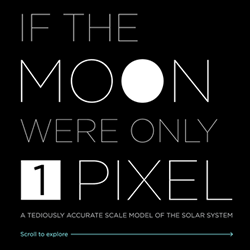
IF THE MOON WERE ONLY 1 PIXEL visualizes the scale of the solar system.
Using a series of slides, this fascinating model of solar system uses the scale of 1 pixel equal to 3474.8 kilometers (or the distance from New York to Las Vegas). As users scroll from the sun through the planets and moons in our solar system, interesting statements and facts appear on the screen.
A button is used to show how quickly light travels. An option is provided to change the scale to amounts such as miles, light minutes, buses, and blue whales. Users can also jump to specific objects in the solar system.
Librarians will find this web-based project to be a fun way to explore scale in both math and science. Use it in a display featuring books about scale and the solar system.

Monday, September 12, 2016

Technology Review: NASA's Eyes

NASA’S EYES is a website and apps that can be used to explore Earth, the solar system, and the universe along with the spacecraft used for exploration.
While some of the interactives are browser-based, others require the NASA’s Eyes app.
Interactive visualizations include Juno, Eyes on the Earth, Eyes on the Solar System, and Eyes on Exoplanets. Solar system tours are also available.
The Events on Earth section explores recent events on our own planet including dust storms, fires, and hurricanes using satellite imagery.
DSN Now is a live web app that allows users to see which spacecrafts are currently active.
Finally, Experience Curiosity is a WebGL experience that allows users to learn about the Curiosity rover as it explores Mars.
Librarians will find this website a great way to get young people excited about space and space exploration. Use the website and apps to jumpstart research projects.
To visit the website, go to http://eyes.nasa.gov/

Friday, July 22, 2016

Website Review: NASA WAVELENGTH

NASA WAVELENGTH provides a full spectrum of resources for science education.
Sponsored by NASA, this website provides access to a digital collection of Earth and space science resources for all grade levels. Specifically, they focus on helping students develop an understanding of our planet Earth, our Sun and solar system, and the universe.
The Science Data and Images section is divided into introductory, intermediate, and advanced resources. The page shares key online collections and descriptions of these resources.
The Strandmaps page links to interactive concept maps on specific science and math topics in the areas of the physical setting, the nature of science, the living environment, the designed world, habits of mind, the nature of technology, and common themes. Each map introduces related concepts, how the concepts are aligned to benchmarks and standards, and links to resources.
The blog provides news, updated information, and resources of interest to educators in a wide range of topics such as astronomy, astrophysics, citizen science, data, and others.
A search tool can be used to find resources by key word and audience. Materials can also be explored by grade level. Finally, links are provided to key multimedia resources including apps, videos, and images.
Librarians will find these resources to be popular with science teachers. Work with teachers to align the materials with the curriculum.
To visit the website, go to http://nasawavelength.org/.

Friday, May 20, 2016

Series Review: Explore My World

The EXPLORE MY WORLD series by Becky Baines helps young children learn about the world around them.
Featuring a wide range of topics, each informational book contains facts and reflective questions to get young children thinking.
DOLPHINS provides a look at the world of dolphins including their characters, habitat, life cycle, and what they eat. It defines key concepts, provides a labeled diagram, and introduces the idea of marine mammals.
PLANETS defines the concept of planet and provides a map of planets. Using age-appropriate language and examples, the book helps children better understand Earth and how other planets are alike and different from Earth.
Librarians will find this series to be an excellent way to introduce informational reading to young children. With many books in the series to choose from, ask students to explore a book of interest and share their questions. Use the books as part of a buddy reading program with older children who might share their interest in science topics.
Published by National Geographic Kids on March 8, 2016. ARC courtesy of the publisher.