Showing posts with label conservation. Show all posts

Monday, August 28, 2023

Synergy: Celebrating National Park


NATIONAL PARKS are lands set aside and protected by a national government for conservation and preservation. These lands contain distinctive natural and cultural resources such as a landforms, plants, and animals of particular value.


To understand a concept, it’s useful to read a cluster of books related to a theme. Explore these recently published books for young people:


NATIONAL MONUMENTS OF THE USA written by Cameron Walker and illustrated by Chris Turnham explores a wide range of iconic locations around the United States. Organized into eight chapters, a two-page spread identifies the monuments. Then, text blocks, infographics, and other visuals highlight key features of each location. ARC courtesy of Wide Eyed Editions, an imprint of 69 Titles.


ZION NATIONAL PARK by Greg Paprocki is a new book in the YOU ARE HERE! series. This picture book focuses on Zion’s unique geological landscape while sharing key facts about the park. In addition, it provides engaging park activities. ARC courtesy of Little Hero, an imprint of Ingram Publisher Services.


COLORS OF THE NATIONAL PARKS illustrated by Jenny Miriam is a board book featuring a color prominently found in ten national parks such as the brown elks of Yellowstone National Park and green cactus of Zion National Park. ARC courtesy of duopress, an imprint of Sourcebooks.


EYEWITNESS NATIONAL PARKS from DK is a highly illustrated guide to 63 US National Parks. This updated book in the Eyewitness series features stunning photographs and the unique features of each of these amazing places. ARC courtesy of DK, an importing of Penguin Random House.


I AM MADE OF MOUNTAINS written by Alexandra S.D. Hinrichs and illustrated by Vivian Mineker highlights the nature wonders of sixteen National Parks of the United States. Each two-page spread provides a stunning illustration reflecting a majestic location along with lyrical text and information about the particular park.

ARC courtesy of Charlesbridge.


THE STORY OF CONSERVATION written by Catherine Barr and Steve Williams and illustrated by Amy Husband shares the science and history of conservation. Part of the STORY OF… series, readers learn about how the Earth’s natural resources can be cared and protected for future generations. ARC courtesy of Frances Lincoln Children’s Book, an imprint of Quarto Group.


Monday, December 27, 2021

Synergy: Giant Panda


Giant Pandas are a black and white bear native to South Central China. They eat bamboo shoots and leaves. Governments and organizations have worked together to ensure this vulnerable species is able to survive in the wild and in captivity.


Read the recently published picture book then learn more at the website.


BEI BEI GOES HOME: A PANDA STORY by Cheryl Bardoe tells the true story of a rare giant panda born at the National Zoo in Washington DC. The fast-paced narrative incorporates full-color photos and side-bar panda facts to engage readers. The picture book concludes with additional information about pandas.


The GIANT PANDA CAM page from the Smithsonian’s National Zoo provides feeds from two video cameras. In addition, still and video images are also available.


To visit the live cams, go to https://s.si.edu/3CBHwwX.


ARC courtesy of Candlewick Entertainment, an imprint of Candlewick Press.

Monday, October 04, 2021

Synergy: Hemispheres and Seasons

Earth is divided into the Northern and Southern Hemisphere by an imaginary line at the equator. The Earth’s tilt causes the seasons. During different months of the year, different part of the Earth receive more or less of the Sun’s direct rays depending on the Earth’s tilted axis.

Read the recently published nonfiction picture book for youth, then learn more at the websites.

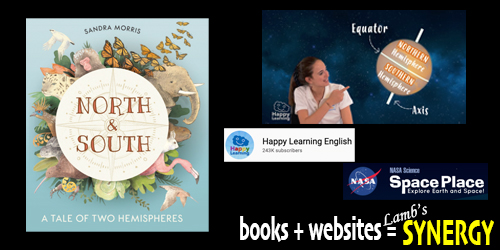
NORTH AND SOUTH: A TALE OF TWO HEMISPHERES by Sandra Morris explores how animals have adapted to the seasons in both the Northern and Southern Hemispheres. Combining engaging illustrations with informational text, two-page spreads explore animals from each hemisphere through the months of the year. Mini-maps of animal habitats and information about conservation status is also provided on each page. The end pages provide additional information about each animal.

NASA’s SPACEPLACE provides a page that answers the question “What Causes the Seasons?” In addition to explaining the seasons, it also discusses the hemispheres. The page includes useful illustrations along with links to additional resources.

To visit SpacePlace, go to https://spaceplace.nasa.gov/seasons/en/

THE SEASONS AND HEMISPHERES is a short YouTube video from Happy Learning English exploring both the seasons and the hemispheres.

To watch the video, go to https://youtu.be/qHgs8dcmB4M.

ARC courtesy of Candlewick, an imprint of Random House.


Monday, August 09, 2021

Synergy: Tree


A tree is a woody perennial plant generally containing a trunk and lateral branches. A root system serves as an underground anchor using moisture and nutrients from the soil. Leaves grow from the shoots. Trees usually reproduce using seeds.

Read the informational picture book for youth, then learn more at the websites:

BE A TREE! written by Maria Gianferrari and illustrated by Felicita Sala skillfully balances poetic connections between trees and humans with useful facts for young scientists. This combination is intended to inspire young people to be kind members of their community as well as environmentally aware global citizens. This beautifully illustrated picture book concludes with an author’s note, anatomy of a tree illustration, additional resources, and calls for environmental and community action.

THANK YOU, TREES! from PBS KIDS PLUM LANDING provides a digital nature sketchpad where children can draw their own trees.

To draw a tree, go to https://to.pbs.org/34AFWMm.

THE TREE GUIDE from the Arbor Day Foundation provides a tree database, glossary, and a page about the anatomy of a tree.

To explore the website, go to https://bit.ly/2RbMmhU.

ARC courtesy of Abrams Books for Young Readers. 

Monday, February 10, 2020

Synergy: Endangered Animals


The Endangered Species Act of 1973 provides for the conservation of endangered and threatened fish, wildlife, and plants. Endangered animals are in danger of extinction, while those listed as threatened are likely to become endangered species in the near future.
WHO AM I? by Tim Flach is a peek-through picture book introducing the concept of endangered animals to young readers. Each two-page spread contains a photograph representing the animal’s habitat, a clue about the animal, and a peek at a part of the animal’s body. In some cases, no habitat is provided but additional visual clues are provided instead.
A second two-page spread reveals the the animal and its name. Children will identify some creatures immediately and others that will be a challenge. The book concludes with information about what makes each animal special and why it’s endangered. Use this book as a fun way to jumpstart an exploration of endangered animals.
ENDANGERED.ORG is the website of a group that strives to stop human-caused extinction of at-risk species. The blog contains up-to-date information of species currently in danger. The campaign focuses on key events such as the Endangered Species Day celebrated in May each year. The endangered species section features pages for key animals including mammals, birds, reptiles, amphibians, fish, plants, and invertebrates. Information and an infographic details the specifics of the Endangered Species Act.
Endangered Species Coalition https://www.endangered.org/
ARC courtesy of Abrams Books for Young Readers.

Monday, November 04, 2019

Synergy: Orangutans


The only great apes of Asia, orangutans are found in the island rainforests of Borneo and Sumatra. They are one of the most intelligent primates and are critically endangered.

Read the recently published children's book, then learn more at the website:

UNDAUNTED by Anita Silvey tells the true story of BirutÄ— Mary Galdikas and her quest to save the orangutans. Each of the highly illustrated chapters connects the world-renowned primatologist with her quest to protect orangutans. 

The Orangutan Foundation website contains fascinating facts about orangutans, information about Galdikas and her work, and recommendations for taking action to save the orangutan.

The Orangutan Foundation https://orangutan.org/

ARC courtesy of National Geographic Kids.

Friday, October 12, 2018

Website: Nature Works Everywhere

NATURE WORKS EVERYWHERE from The Nature Conservancy provides educational resources associated with nature.
The resources section of the website contains lesson plans, videos, virtual field trips, webinars, teacher resources, tip sheets, and other types of resources. Users can search by grade, resource type, standards, themes, or tags.
Use the Nature Works Gardens map to explore over a thousand gardens around the world. The planning tools allows users to design, measure, and track garden activities.
Librarians will find that this website provides useful classroom as well as community connections to nature. Be sure to check out their grant program.
To visit the website, go to https://www.natureworkseverywhere.org/.

Wednesday, August 01, 2018

Website Review: Lazy Green

LAZY GREEN is a website that provides simple ways people can save energy.
The website presents 20 energy saving tips. Each tip is introduced with a simple animation and statement. Readers click the tip to read a short article about the topic. A source is provided for each tip.
Librarians will find this website useful as an information literacy and informational reading activity. Ask each child to read a different tip and summarize what they learned with the class. Then direct students to go to the source of the information and evaluate the website. Advertising is embedded in the page. Use this an an opportunity to discuss product placement at websites.
To visit the website, go to https://www.lazygreen.org/.

Sunday, July 16, 2017

Book Review: Animal Ark

ANIMAL ARK by Kwame Alexander and Joel Sartore celebrates animals through poetry and photographs.
This beautifully presented picture book focuses on quality over quantity. Each page contains an amazing high-quality photograph of a creature along with a short phrase. Together, these pages express the beauty and diversity of nature’s animal world through images and haiku. The book concludes with a description of National Geographic’s Photo Ark project, and a list of animals featured in the book, along with notes from the author and illustrator.
Librarians will find this book provides inspiration for projects focusing on endangered animals. Unlike many animal books that stress factual information, this picture book features the conservation and aesthetic side of nature.
To learn more about the author, go to http://kwamealexander.com/.
To learn more about the photographer, go to http://www.joelsartore.com/.
To visit the PhotoArk, go to http://www.nationalgeographic.org/projects/photo-ark/.
Published by National Geographic Children’s Books on February 14, 2017. ARC courtesy of the publisher.

Monday, November 21, 2016

Website Review: Oceana

The OCEANA website focuses on marine life and conservation.
The Marine Life section contains a database of sea creatures. This Ocean Animal Encyclopedia is filled with fascinating facts and resource organized by types of creatures.
The Publications section includes short and longer scientific reports, brochures, facts sheets, and infographics about the world’s oceans.
The Expeditions area provides an overview of conservation campaigns focusing on unique marine ecosystems around the world.
Librarians will find this website is filled with fascinating information, but readers need to keep in mind that the focus is on conservation. The high-quality infographics would be excellent for students analysis and evaluation. The reports would be useful for informational reading activities.
To visit the website, go to http://oceana.org.

Tuesday, July 12, 2016

Book Review: Ocean Animals

OCEAN ANIMALS: WHO’S WHO IN THE DEEP BLUE by Johnna Rizzo explores all aspects of marine life while also featuring key conservation ideas.
This colorful work of nonfiction begins with an overview of oceans, layers of life, and coral reefs. Next, the book features different categories of marine life. The text concludes with information about habitats and conservation topics. A glossary and index are also provided.
Rather than overwhelming readers with information, this book provides large photographs and small blocks of text making it useful for youth who are resistance to text-heavy books.
Featuring amazing color photographs and easy-to-read blocks of text, librarians will find this fact-filled informational book to be popular with children who enjoy reading about marine life. The book is organized well for students working on research projects related to specific aspects of ocean life.
Published by National Geographic Kids on May 17, 2016. ARC courtesy of the publisher.

Thursday, June 16, 2016

Book Review: Gorillas Up Close

GORILLAS UP CLOSE by Christena Nippert-Eng is an amazing, informational book exploring all aspects of the gorilla world.
Designed for middle grade readers, the book contains dozens of short chapters examining the lives of gorillas both in the wild and living in zoos. While learning facts about these creatures, readers will also enjoy getting to know individual gorillas by name. The book concludes with tips, additional resources, an author’s note, and index.
From the adorable cover photograph to the attractive layout, librarians will find readers immediately engaged in this impressive work of nonfiction. Photos, maps, diagrams, and fact boxes will also draw in readers. The book will be of interest to readers who enjoy nonfiction narrative as well as those who are seeking a title useful in research projects.
Published by Henry Holt and Company, an imprint of Macmillan on April 19, 2016. ARC courtesy of the publisher.

Friday, May 06, 2016

Book Series Review: Mission Rescue

The MISSION RESCUE series from National Geographic is intended to inspire young people to learn about endangered animals and how they can be saved.
MISSION SHARK RESCUE begins by exploring the threats facing sharks. Then, each chapter explores some aspect of sharks including their role as predators, their habitat, life cycle, physical characteristics, and connection with humans. Stories, facts, photos, and rescue activities and challenges are woven through the book to keep readers engaged.
MISSION PANDA RESCUE examines the reasons why pandas are endangered. The six chapters explore the panda’s habitat, characteristics, families, and relationship with people. The many photographs and other visuals bring these animals to life. Interesting stories, interviews, facts, and activities help generate reader interest in saving these adorable creatures.
The series also includes titles focusing on lions, wolves, polar bears, elephants, tigers, and sea turtles.
Librarians will find that this series appeals to animals lovers as well as children who enjoy nature, the environment, and social change. Students who enjoy biographies will like the many one-page interviews woven through the books. The focus on photographs, infographics, and small blocks of text will be of interest to nonfiction fans.
Published by National Geographic Children’s Books on March 8, 2016. ARC courtesy of the publisher.

Tuesday, March 15, 2016

App Review: WWF Together

WWF TOGETHER is an informational app exploring wildlife and conservation topics and issues of interest to all ages.
From pandas to monarch butterflies, users choose from over a dozen threatened and endangered animals to explore. Each infographic includes text, photographs, diagrams, and other information about the creature.
Users can also explore information through the use of an interactive world map. Clicking on a location pops up an infographic containing information about an animal living in that area.
Because this app is sponsored by an organization that focuses on conservation, a section of the app features ways users take action.
Finally, the news area provides up-to-date information on wildlife and conservation issues.
Librarians will find that this app is a good way to help users learn to navigation and interpret infographics. The short, easy-to-read articles would be useful for informational reading activities. Connect information literacy skills with science learning for an authentic learning experience.

Friday, January 01, 2016

Tech Review: Reef Defender

REEF DEFENDER is an app from the Department of Land and Natural Resources of Hawaii.
Before jumping into the game, app users are encouraged to explore the Hawaii Sharks website to learn more about sharks, Hawaiian mythology, shark safety, and shark incidents. An shark quiz is also available. Students will also enjoy following sharks with the Tiger Shark tracker.
After learning about the importance of the reefs to sharks, app players use their pet shark to boot bad items that can harm the reef out of the ocean. Bad items include bottles, cans, cigarettes, invasive species, motor oil, herbicides, and fertilizer.
Librarians will find this game to be a nice way to motivate youth to explore the informational website about sharks. Add this app to a learning center that includes books about reefs and reef creatures.
The app is available for both Apple and Android.
To explore the website, go to http://dlnr.hawaii.gov/sharks/.

Saturday, December 05, 2015

Tech Review: National Aquarium

THE NATIONAL AQUARIUM app and website provide fascinating information about thousands of animals.
Sponsored by a nonprofit focusing on the world’s aquatic treasures, the website features a high-quality encyclopedia, webcams, and educational information.
The searchable Animals encyclopedia includes high quality photographs and information about thousands of creatures along with a link to the exhibit where this animal is found.
Their blog contains informative stories about science, conservation, and animals.
The teacher section includes printable booklets and fact sheets.
While the app doesn’t provide the detailed encyclopedia found at the website, it does provide a guide for visits and fun facts about the animals.
To visit the National Aquarium website, go to http://aqua.org/
Go to the Animals section of the National Aquarium website athttp://www.aqua.org/explore/animals.

Friday, November 20, 2015

Technology Review: Global Shark Tracker

GLOBAL SHARK TRACKER by Ocearch is a science app and website that allows users to track the movement patterns of sharks using a satellite tracking system.
Both the app and website contain the same features.
In the Shark Tracker section, users can track sharks by recent activity, gender, stage of life, or location tags. Shark locations can be explored on a world map. Clicking a shark presents a photo, date, gender, tag date, and location. Clicking the “view more” option provides additional information including the shark’s name, species, stage in life, physical characteristics, and miles traveled. A description provides details such as the shark’s life experiences. It’s also possible to see the path where the shark has traveled.
The Science section provides detailed information about the science behind the project including the approach, methodology, research projects, expeditions, scientists involved, and papers published.
The Education area provides STEM lessons for Grades 3-5 and 6-8.
Users can also use the website and app to connect with the Facebook, Twitter, YouTube, Instagram, and Blogger social media resources.
Librarians will find this science app to be an engaging way to learn about the navigation patterns of sharks. Pair the app with nonfiction books about sharks and shark conservation.
To visit the website, go to http://www.ocearch.org/.

Monday, March 16, 2015

Website Review: Smithsonian National Zoological Park

The SMITHSONIAN NATIONAL ZOOLOGICAL PARK website is a fun way to learn about animals and science.
Start your website exploration with the “Zoo News”. These press releases contain text, images, and sometimes video associated with a news item such as the birth of an animal or a new scientific discovery. They’re great for informational reading or for current events activities.
The “Meet Our Animals” section of the website is likely to be the most popular area with children. The Animal Index provides images and in some cases information about hundreds of mammals, birds, reptiles, amphibians, and fish in the collection. If you can’t visit the zoo in person, you can still enjoy the animals live on the zoo cams. In addition, users can explore groups of animals and exhibits. Many of these pages contains information and activities. The “National Zoo E-Cards” page provides access to animal images and the opportunity to write a message and send it through email.
The “Science” section of the website explores the conservation activities of the zoo. These research initiatives, laboratories, and centers are a great way for youth to learn about the scientists who work behind-the-scenes at the zoo and in the field. These projects would be a effective way to jump-start student science projects.
The “Conservation Central” online habitat education program is a fun way for youth to learn about the animals of temperate forest habitats. This section includes curriculum materials along with online interactives.
The “Smithsonian Biodiversity Science in the Classroom” materials provide videos and lessons plans for upper elementary students.
The website is available at http://nationalzoo.si.edu. To extend the experience, be sure to check out their social media presence including Facebook, Twitter, Flickr, YouTube, and Instagram sites to keep up on the latest news and information about the zoo and its animals.
In addition to the website, an app is available from both the App Store and Google Play at http://nationalzoo.si.edu/SmithsonianNationalZooApp/. While the app includes features such as an interactive map and schedules for zoo visitors, it also provides lots of useful information such as an animal index and live animal cams for those not able to visit in person.

Thursday, December 18, 2014

Website Review: Whale Wars

WHALE WARS: BLOOD AND WATER is an award-winning interactive experience from Animal Planet that is sure to jumpstart a discussion about environmental issues, conservation, and the role of activism.

The website is divided into five video chapters. Each section provides concise text along with stunning illustrations and engaging video clips. The visuals include current and historical photographs, maps, infographics, diagrams, and timelines. Many of the images contain interactive elements for further exploration.

Involve students in examining the real-world organizations involved in this program. Ask them to explore the different perspectives and concerns of environmental groups, countries, and corporations.

To explore this resource, go to http://blood-and-water.animalplanet.com/.
Follow the TV show at https://www.facebook.com/WhaleWars.

Monday, September 29, 2014

Book Review: The Case of the Vanishing Little Brown Bats

THE CASE OF THE VANISHING LITTLE BROWN BATS: A SCIENTIFIC MYSTERY by Sandra Markle follows a group of scientists as they investigate the disappearance of the beloved brown bat population. This engaging mystery combines a well-researched narrative with high-quality color photographs.

Like her award-winning scientific mysteries focusing on golden frogs and honeybees in “The Case of the Vanishing…” series, this book focuses on a real-world investigation. The scientific aspects are made accessible through clear explanations and authentic examples.

The book’s layout will appeal to youth readers. Annotated photographs are useful for children who wish to skim the book before reading. Maps and labeled diagrams help readers visualize key concepts. Interesting questions are used as headings and subheadings to guide reading.

Additional resources provided by the author will be of particular interest to teachers and librarians. These include an author’s note, local/global efforts, glossary, digging deep information, and an index. In addition, the exemplary informational text would be useful in addressing the Common Core Curriculum.

While many library collections already have many “fact books” about bats, this book provides a unique, fresh perspective on the topic.

The combination of fascinating science with an engaging mystery are perfect of the target youth audience.

Learn more about Sandra Markle and her books at her blog at http://sandra-markle.blogspot.com/.


NetGalley ARC used for review