Showing posts with label STEM. Show all posts

Monday, September 25, 2023

Synergy: Exploring Earth Science


EARTH SCIENCE is the branch of science that studies the physical makeup of the Earth and its atmosphere. It includes the areas of geology, astronomy, oceanography, and meteorology. 


To understand a concept, it’s useful to read a cluster of books related to a theme. Explore these recently published books for young people:


FIRE SHAPES THE WORLD written by Joanna Cooke and illustrated by Cornelia Li explores the connection between fire and life on earth. While exploring key concepts related to fire ecology, readers learn about how fire shaped earth and its inhabitants and continues to have an impact on the environment. With so many people impacted each year by wildfires, this beautifully illustrated picture book is timely. An author’s note provides additional depth and detail. ARC courtesy of Yosemite Conservancy, Ingram Publisher Services.


WATER: HOW WE CAN PROTECT OUR FRESHWATER written by Catherine Barr and illustrated by Christiane Engel examines the history of water on earth, the importance of freshwater, and the need to advocate for water security. Each two-page spreads explores a key concept presenting facts and examples along with useful illustrations. The picture book concludes with ideas for using water wisely. ARC courtesy of Candlewick, an imprint of Penguin Random House.


KABOOM! A VOLCANO ERUPTS written by Jessica Kulekjian and illustrated by Zoe Si takes young readers through the experience of a volcanic eruption. Told from the volcano’s viewpoint, young volcanologists learn key concepts, facts, and terminology. The comic approach will appeal to young readers. The picture book concludes with useful back matter including a volcano anatomy diagram and volcano types. ARC courtesy of Kids Can Press, an imprint of Hachette.


EXPLORE UNDER THE EARTH written by Carly Madden and illustrated by Neil Clark takes readers on an adventure inside the Earth. This innovative, layered board book introduces young children to earthquakes, volcanoes, and other aspects of earth science. Check out other books in the Adventures of Evie and Juno series for more science fun. ARC courtesy of Happy Yak, Quarto Group.


Monday, September 18, 2023

Synergy: Exploring Hands-on Science


HANDS-ON SCIENCE is an approach to learning that actively involves children in inquiry-based learning and problem-solving. Using real-world contexts, children apply critical and creative thinking to investigate questions, conduct experiments, and draw conclusions.


To understand a concept, it’s useful to read a cluster of books related to a theme. Explore these recently published books for young people:


HANDS-ON SCIENCE is a new nonfiction series for young readers focusing on a wide range of popular science themes. Written by Lola M. Schaefer and illustrated by Druscilla Santiago, each book uses simple illustrations, engaging text, and creative interactive elements to explain key scientific concepts. Along the way, children are encouraged to have fun conducting their own experiments. Whether tilting the book, blowing on the page, or pressing an image, readers are actively involved in learning. Each title immerses children in a different STEM science laboratory where they use the book along with step-by-step instructions to conduct experiments.


GEOLOGY examines concepts connected with rocks, minerals, and Earth science. From earthquakes to volcanoes, children will enjoy connecting science to exciting, real-world situations.


MATTER introduces young scientists to solids, liquids, and gases. From molding clay and making cherry juice to experimenting with bubbles, readers immerse themselves in an engaging chemistry laboratory.


MOTION explores topics such as gravity and wind to explain force and motion. Young scientists will enjoy actively learning in the physic laboratory.


ARC courtesy of Charlesbridge, an imprint of Penguin Random House.

Friday, September 01, 2023

Timely Takeaways: Space Science

From meteorites to aliens, explore a wide range of recently published books focusing on space science, astronomy, and cosmology. These thought-provoking books separate the fact from the fiction.

Impact: How Rocks from Space Led to Life, Culture, and Donkey Dong
Greg Brennecka, 2022, William Morrow, Harper Collins
Themes: Science, Space Science, Cosmology

Brennecka’s humorous approach brings the story of meteorites to life through fascinating examples.

Take-aways: Use the author’s stories to enhance the teaching of space science and specifically meteorites.

NASA Missions to Mars: A Visual History of Our Quest to Explore the Red Planet
Piers Bizony, 2022, Motorbooks, Quarto Group   
Themes: Science, Space Science, Space Exploration

This visually-rich reference explores the past, present, and future of Mars exploration.

Take-aways: Use this amazing visual story to enhance the planetary science curriculum. Involve students in speculation about the future exploration of other planets in our solar system.

The Red Planet: A Natural History of Mars
Simon Morden, 2022, Pegasus Books, Simon & Schuster                 
Themes: Science, Space Science

Told in seven parts, readers explore the planetary science, geology, and the history of Mars.

Take-aways: The author’s accessible, conversational writing style make this book a good choice for high school educators seeking a content-area reading experience for teens.

The Cosmos Explained
Charles Liu, 2023, Ivy Press, Quarto Group                   
Themes: Science, Space Science, Astronomy

With an emphasis on our place in space and time, this visually-rich book traces the history of our universe and the evolution of our social system. 

Take-aways: Teachers will find the short biographical sketches of key contributors to be useful.

Before the Big Bang: The Origin of Our Universe from the Multiverse
Laura Mersini-Houghton, 2023, Mariner Books, HarperCollins     
Themes: Space Science, Cosmology

Follow the author’s personal and professional journey re-writing the origin story of our universe.

Take-aways: Students are fascinated by the prospect of a multiverse. Update the curriculum to include the latest information on the universe’s origin.

Under Alien Skies: A Sightseer’s Guide to the Universe
Philip Plait, 2023, W.W. Norton & Company                   
Themes: Science, Space Science, Astronomy

Plait takes readers on an entertaining adventure through the universe. From the moon and Mars to black holes, each chapter explores a different space science topic.

Take-aways: Weave Plait’s humorous, easy to understand examples into the space science curriculum.

Interstellar: The Search for Extraterrestrial Life and Our Future in the Stars
Avi Loeb, 2023, Mariner Books, HarperCollins     
Themes: Science Space Science, Space Exploration

Loeb examines that challenges of encountering alien life and our quest to explore the universe.

Take-aways: Use this book to address student speculation about aliens and interstellar exploration.

The Little Book of Aliens
Adam Frank, 2023, Harper, HarperCollins                                       
Themes: Science, Space Science

Through eight engaging chapters, readers learn the fact and fiction of alien life. Trace the history of the big ideas, scientific exploration and research, and near-future issues.

Take-aways: Students often have questions about the possibility of alien life. Use examples from this easy-to-understand book to lead thought-provoking discussions about this hot topic.

...

Whether helping educators keep up-to-date in their subject-areas, promoting student reading in the content-areas, or simply encouraging nonfiction leisure reading, teacher librarians need to be aware of the best new titles across the curriculum and how to activate life-long learning. - Annette Lamb


Monday, March 27, 2023

Synergy: Microscopic Scale


MICROSCOPIC SCALE examines the size of things that are smaller than can be seen by the naked eye. To view these objects and events requires a microscope or other specialized lens.


Read the recently published nonfiction picture book for children, then learn more at the websites:


THE UNIVERSE IN YOU: A MICROSCOPIC JOURNEY by Jason Chin takes picture book readers on a scientific adventure from the smallest bird and skin cells to atoms and molecules. Chin combines beautiful illustrations with an engaging life science story to bring the microscopic world alive for children. The book concludes with useful scientific explanations for adults reading with children. ARC courtesy of Neal Porter Books.


THE MICROSCOPIC SCALE from Science Learning Hub provides an overview of key concepts, a glossary, and related information. To visit the website, go to https://www.sciencelearn.org.nz/resources/497-the-microscopic-scale


SMALL WORLD PHOTOMICROGRAPHY from shares outstanding examples of images recorded through a light microscope. Use these images to jumpstart a discussion about microscopic scale. To visit the website, go to https://www.nikonsmallworld.com//galleries/photomicrography-competition

Monday, December 19, 2022

Synergy: Concrete


CONCRETE is a composite material made of stone, sand, water, and cement. From bridges and dams to lighthouses and skyscrapers, concrete is used in a wide range of construction projects.


Create a display featuring concrete examples, building models, and LEGO bricks. Ask children to design a building that could be made with concrete.


Read the recently published nonfiction children’s picture book, then learn more at the website:


CONCRETE: FROM THE GROUND UP by Larissa Theule and illustrated by Steve Light defines concrete and traces its history. Part of the Material Marvels series, readers learn about the many types of structures built with concrete. The illustrator’s use of speech bubbles on captivating color drawings along with the author’s short, informational texts combine for an engaging and informative picture book. ARC courtesy of Candlewick Press. 


CONCRETE from Kids Britannica defines concrete and provides several examples in an easy-to-read format.


To read the article, go to https://kids.britannica.com/kids/article/concrete/403923.


WHAT IS CONCRETE? from Concrete Network provides an introduction to concrete, its components, and its uses. Users can access numerous articles for further information.


To learn more, go to https://www.concretenetwork.com/concrete.html.


WHAT IS CONCRETE? from Practical Engineering is a short video explaining the basics of concrete. Other videos in the series explore Roman concrete.


To view the video, go to https://youtu.be/UOHURuAf5iY.


Monday, May 30, 2022

Synergy: Jokes

Jokes are humorous stories with a funny conclusion known as a punchline. Riddles and one-liners are very short jokes. Jokes are not intended to be taken seriously. 

Read the recently published children’s nonfiction book, then learn more at the websites:


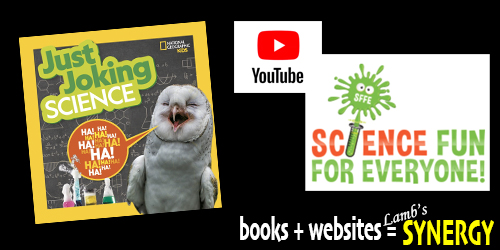
JUST JOKING SERIES from National Geographic Kids includes dozens of titles. JUST JOKING SCIENCE is filled with 300 STEM-focused jokes, riddles, knock-knocks, tongue twisters, and more. In addition, readers learn about ten wacky, but real scientific experiments.


JUST JOKING-LOL is a YouTube video playlist containing dozens of short videos with animal jokes and funny riddles from National Geographic Kids.


Go to https://youtube.com/playlist?list=PLQlnTldJs0ZSwXZodadqpS_vv0NXXB-GC


SCIENCE FUN FOR EVERYONE features science jokes submitted by children. Encourage students to write their own STEM jokes.


Go to https://www.sciencefun.org/kidszone/jokes/


ARC courtesy of National Geographic Kids.

Monday, April 18, 2022

Synergy: Botany


Botany is the branch of biology that explores the science of plant life including fungi and algae. This multidisciplinary area includes structure, growth, reproduction, taxonomy and more.


Read the recently published nonfiction book for children, then learn more at the websites:


ENCYCLOPEDIA OF PLANTS, FUNGI, AND LICHENS FOR YOUR READERS by Tereza Nemcova and Tomas Pernicky is part of the Encyclopedias for Young Readers series. Each two-page spread focuses on a different category of plant, fungi, or lichen. The simple illustrations and short text descriptions introduce the concept and several examples found around the world. Of particular note are the fungi and lichen often overlooked in science books for children.


USDA’s PLANTS database contains information about vascular plants, mosses, liverworts, hornworts, and lichens from the U.S. and its territories.


PLANTS Database

https://plants.usda.gov/ 


The US Forest Service provides useful resources on fungi and natives plants found in the United States.


Lichens from the U.S. Forest Service

https://www.fs.fed.us/wildflowers/beauty/lichens/


The Mighty Fungi from the U.S. Forest Service

https://www.fs.fed.us/wildflowers/ethnobotany/Mind_and_Spirit/fungi.shtml


Native Plants from the US Forest Service

https://www.fs.fed.us/wildflowers/Native_Plant_Materials/index.shtml


ARC courtesy of Albatros Media.

Monday, April 04, 2022

Synergy: Lise Meitner


Lise Meitner (1878-1968) was an Austrian-Swedish physicist best known for her discovery of nuclear fission along with the element protactinium.


Read the recently published nonfiction book for youth then learn more at the website.


THE WOMAN WHO SPLIT THE ATOM by Marissa Moss tells the compelling story of a female Jewish physicist who made groundbreaking discoveries, while dealing with sexism, anti-Semitism, and other obstacles. Each of the forty chapters begins with sequential art followed by a short, engaging narrative. The book concludes with an afterword with photographs, author’s note, timeline, terms, glossary, endnotes, bibliography, and index. Perfect for reluctant readers, this highly illustrated biography will appeal to a wide range of young people.


LISE MEITNER AND NUCLEAR FISSION is a very short video providing an overview of Lise Meitner’s scientific discovery.


To view the video, to go https://youtu.be/6UvbdidT-qM 


THE AMAZING LIFE OF LISE MEITNER is a video exploring the life of this inspiring scientist.


To view the video, to go https://youtu.be/uZZFG58G_jE


ARC courtesy of Abrams Books for Young Readers.

Monday, January 31, 2022

Synergy: Oxygen


Oxygen is a chemical element required by animals. When an animal breathes, it takes in oxygen. Animals need oxygen to survive. 


Read the recently published nonfiction picture book for youth then learn more at the website.


BLOWHOLES, BOOK GILLS, AND BUTT-BREATHERS by Doug Wechsler is an engaging picture book describing how animals get their oxygen. Part of the HOW NATURE WORKS series, this title features photographs along with high quality diagrams. Specific animals are used to highlight different ways creatures breath and use oxygen.


HOW DO ANIMALS BREATHE? Is a one-page overview from the New Mexico Museum of Art that explains breath taking.


To read the document, go to https://bit.ly/3IgNpSO


BREATHING IN ANIMALS is a short video explaining the different organs animals use for breathing.


To view the video, go to https://youtu.be/cPOl1CYvNKo


ARC courtesy of Tilbury House Publishers, an imprint of W. W. Norton.

Monday, December 20, 2021

Synergy: Architecture


Architecture is the art, science, and practice of designing and constructing structures such as buildings, bridges, and outdoor spaces.


Read the recently published work of nonfiction for youth then learn more at the website.


ADVENTURES IN ARCHITECTURE FOR KIDS by Vicky Chan is the second book in the new Design Genius Jr. series. The book features 30 design projects for children. Each hands-on activity explores a different aspect of STEAM discovery and learning associated with the architecture theme including general construction, architecture and history, landscape architecture, sustainable architecture, and city planning. Each project provides an overview, materials and tools needed, step-by-step instructions with photographs, and notes.


Architecture at Home is a web-based project from the Center for Architecture featuring two dozen, hands-on architecture activities for children. These short, easy design projects use readily available materials. Each project includes an overview, videos, step-by-step instructions, and a downloadable PDF.


To learn more, go to https://bit.ly/2ZKb0u4.


Use the book and website in a makerspace exploring architecture themes.


ARC courtesy of Rockport Publishers, an imprint of the Quarto Group.

Monday, November 22, 2021

Synergy: Engineers


Engineers invent, design, construct, and test a wide range of machines, systems, and structures. Bridges, buildings, and other physical structures are just a few of their projects. Although many professional are involved in these projects, engineers apply math and physics to create innovative solutions to address the world’s problems from homes that use less space to energy efficient buildings.


Read the recently published picture book for youth then learn more at the website.


COLOSSUS written by Colin Hynson and illustrated by Giulia Lombardo shares the world’s most amazing feats of engineering. From buildings and bridges to monuments from around the world, this large format picture book uses annotated illustrations to trace the history of engineering projects from the ancient world to the present and future. The book concludes with a glossary and index.


SEVEN WONDERS: ENGINEERING FEATS is a StoryMap from the American Society of Civil Engineers. The web page features modern engineering marvels from around the world. Each structure includes an image, description and map showing its location.


To learn more, go to https://bit.ly/3Ex3DoL


ARC courtesy of Big Picture Press, an imprint of Candlewick Press.

Monday, November 08, 2021

Synergy: Nanotechnology


Nanotechnology involves the use of matter on a very tiny scale. Atoms and molecules are manipulated for fabrication of products for various industries including nano medicine, nano electronics, and biomaterials.

Read the recently published picture book for children then learn more at the website.

NANO by Jess Wade and illustrated by Melissa Castrillon describes the science of nanotechnology. This engaging picture book provides an introduction to atoms, the elements, and basic science concepts. Designed to inspire young scientists, it focuses on how nano materials are used in every day life. Key terms are highlighted in the text. The book concludes with more detailed information about nano science.

NANO.GOV is the website of the National Nanotechnology Initiative. The website contains information for scientists, educators, and students. The Nano 101 section features key concepts related to nanotechnology. The Educational Resources section includes useful learning materials for both students and teachers such as links to the e-zine Nanooze, information about the NanoDays festival, and access to the VizLab image collection.

To learn more, go to https://www.nano.gov/.

ARC courtesy of Candlewick Press.

Monday, August 09, 2021

Synergy: Tree


A tree is a woody perennial plant generally containing a trunk and lateral branches. A root system serves as an underground anchor using moisture and nutrients from the soil. Leaves grow from the shoots. Trees usually reproduce using seeds.

Read the informational picture book for youth, then learn more at the websites:

BE A TREE! written by Maria Gianferrari and illustrated by Felicita Sala skillfully balances poetic connections between trees and humans with useful facts for young scientists. This combination is intended to inspire young people to be kind members of their community as well as environmentally aware global citizens. This beautifully illustrated picture book concludes with an author’s note, anatomy of a tree illustration, additional resources, and calls for environmental and community action.

THANK YOU, TREES! from PBS KIDS PLUM LANDING provides a digital nature sketchpad where children can draw their own trees.

To draw a tree, go to https://to.pbs.org/34AFWMm.

THE TREE GUIDE from the Arbor Day Foundation provides a tree database, glossary, and a page about the anatomy of a tree.

To explore the website, go to https://bit.ly/2RbMmhU.

ARC courtesy of Abrams Books for Young Readers. 

Monday, August 02, 2021

Synergy: Wildlife


Wildlife are undomesticated creatures that live separate from direct human interference. Global populations of wildlife are rapidly decreasing due to human activity such as habitat destruction.

Read the informational picture book series for youth, then learn more at the websites:

GO WILD! is a new series for young readers from National Geographic Kids. SEA TURTLES is the first book in this informational reading collection for ages 4 through 8. Each title has a similar format including a two-page spread and topics such as habitat, map, size, anatomy, relatives, food, and babies. Pages related to conservation issues are likely to inspire children to care for these creatures. A timeline and glossary are useful for curriculum connections. Fun facts and activities extend the experience. The parallel format of each book makes them particularly useful for small group activities.

Upcoming titles in the series include PANDAS, ELEPHANTS, and LEMURS.

LEAVE WILD ANIMALS IN THE WILD is a short online article providing wildlife tips for children.

To read the article, go to https://bit.ly/3uGZOIg.

EXPLORE provides access to dozens of live streaming cameras students and educators can use to observe wildlife.

To view the cameras, go to https://explore.org/livecams.

ARC courtesy of National Geographic Kids.

Monday, July 19, 2021

Synergy: Camouflage


Camouflage is a defense mechanism used by creatures to blend into their environment. Also called cryptic coloration, these organisms are able to disguise their appearance, location, and even movement.

Read the informational picture book for youth, then learn more at the websites:

MASTERS OF DISGUISE: CAMOUFLAGING CREATURES & MAGNIFICENT MIMICS by Marc Martin uses brightly colored watercolor and cut-outs to explore the world of biomimicry in nature. Featuring a dozen animals from around the world, readers learn about how each creature is able to blend into its natural habitat. Of particular note are the seek-and-find activities woven throughout the book to get students thinking about the importance of observation in the natural world.

CAN YOU FIND THE CAMOUFLAGED ANIMALS? from Earth Rangers shows viewers an image and asks them to identify the creature. After revealing the answers, viewers learn facts about the creature. This video would be effective as a whole class, small group, or individual activity.

To view the video, go to https://youtu.be/kGZX1_Zy-74.

32 EXAMPLES OF CAMOUFLAGE IN NATURE is an online article containing lots ideas educators can use to teach about how predators and prey animals use camouflage.

To read the article, go to https://bit.ly/34FJXiJ.

ARC courtesy of Candlewick Press.

Monday, July 12, 2021

Synergy: Vaccination

Vaccination is the process of administering a vaccine. Vaccines are used to prevent illness from an infectious disease such as smallpox or polio. Vaccines work by helping the patient’s immune system develop protection from the disease.

Read the work of graphic science for youth, then learn more at the websites:

A SHOT IN THE ARM! by Don Brown is the third book in the “Big Ideas that Changed the World” series of juvenile nonfiction graphic science books. From smallpox to COVID-19, this engaging graphic science book examines the history of deadly disease and the essential role of vaccinations in saving lives. Told through high-quality, engaging illustrations and concise text, this timely work shares the science behind vaccinations and the key scientists who have made them possible. Although the book primarily on the history of smallpox, other diseases are also woven into the story.

THE HISTORY OF VACCINES provides a timeline, articles, and activities exploring the development and use of vaccines through time.

To visit the website, go to https://www.historyofvaccines.org/.

THE UNTOLD STORY OF THE FIRST VACCINE from SciShow shares the long history of smallpox and how medical breakthroughs across thousands of years lead to the vaccine.

To watch the video, go to https://youtu.be/jtqAqL3fn64.

VACCINES 101 from Nature is a short video describing how vaccines work in the human body.

To watch the video, go to https://youtu.be/4SKmAlQtAj8.

ARC courtesy of Amulet Books an imprint of Abrams.

Monday, June 21, 2021

Synergy: Dark Matter and Vera Rubin


Dark matter is made up of particles that do not emit, reflect, or absorb light. It can’t be seen directly or detected through electromagnetic radiation, so we only know about it through its effect on objects that we can observe.

Vera Rubin (1928-2016) was an American astronomer who provided some of the first scientific evidence of dark matter and expanded our understanding of how galaxies work.

Read the informational picture book for youth, then learn more at the website:

THE STUFF BETWEEN THE STARS is a biographical picture book exploring the life of astronomer Vera Rubin. This inspirational story shares the challenges Rubin had as a woman astronomer along with the process of making her discoveries about dark matter and the universe.

VERA RUBIN AND DARK MATTER is a short article about Rubin and her scientific discoveries from the American Museum of Natural History.

To read the article, go to https://bit.ly/3i5HAgZ.

Open Mind’s VERA RUBIN AND DARK MATTER is an engaging short video exploring her life and work.

To watch the video, go to https://youtu.be/pkrljGUJOPA

DARK MATTER from NASA’s SpacePlace explains the basics of dark matter to children.

To read the article, go to https://go.nasa.gov/3i12AWe.

ARC courtesy of Abrams for Young Readers.

Monday, June 07, 2021

Synergy: Women of STEM

Historically, women have been under-represented in the areas of science, technology, engineering, and math (STEM). According to a AAUW report, women make up only 28% of the STEM workforce. Gender gaps are particularly high in computing and engineering. Recent support for STEM education increases the likelihood that more young women may select these careers.

Read the informational book for youth, then learn more at the website:

WONDER WOMEN OF SCIENCE written by Tiera Fletcher and Ginger Rue and illustrated by Sally Wern Comport explores a dozen STEM professionals who have made major contributions to science. Each biography contains a fact box and short narrative with illustrations. Readers learn about the spark that got them started, their eureka moment, note to self, note to you, and words to live by. Each narrative concluded with information about their specializations. The book concludes with a glossary and suggestions for activities and further reading.

THE UNTOLD HISTORY OF WOMEN IN SCIENCE AND TECHNOLOGY is a webpage sharing the diverse stories of women across the fields of science, technology, engineering and math. Users can read a short biography, then listen to a SoundCloud podcast that shares their story. To explore this resource, go to https://bit.ly/3wwR89E.

The AAUW’s THE STEM GAP report shares research regarding women in science, technology, engineering and math. To read the report, go to https://bit.ly/3dD729K.

ARC courtesy of Candlewick Press.

Monday, December 07, 2020

Synergy: Simple Machines


A simple machine is a device containing few or no moving parts that makes work easy. A lever, pulley, inclined plane, wedge, screw, and wheel and axle are classic examples. These mechanical devices use changes in direction or magnitudes of force to do perform a task.

Read the recently published picture book, then learn more at the website:

NEWTON AND CURIE: THE SCIENCE SQUIRRELS by Daniel Kirk features two STEAM loving squirrels who use their knowledge of simple machines to solve real-world problems.

GENERATION GENIUS is a K-8 teaching resource that pairs educational videos with science standards aligned lessons and activities. For instance, their Simple Machines video is accompanied by discussion questions, vocabulary, reading material, activities, lesson plan, teacher guide, and assessment. Limited access is available without a subscription.

To visit Generation Genius, go to https://bit.ly/35iSVUj.

ARC courtesy of Abrams.