Showing posts with label slavery. Show all posts

Monday, December 13, 2021

Synergy: Black Seminole People


The Black Seminole people are the descendants of Seminole Indians combined with free Blacks and escaped enslaved people of African lineage. Although Florida had been a refuge for freedom-seeking enslaved people, the Black Seminole people ultimately migrated to Oklahoma, Texas, and Mexico in the mid 1800s.


Read the recently published biography for youth then learn more at the websites.


A MAN CALLED HORSE by Glennette Tilley Turner tells the true story of a man of Seminole and African descent who lead his people from Florida to a new home in the West during the 19th century. This well-researched biography reflects the many roles of John Horse from counselor and army captain to conductor on the Underground Railroad. Told through short, visually-rich chapters, Turner follows John Horse’s quest while also providing the larger context of the challenges facing the Black Seminole people. The book concludes with the lasting legacy, additional information, timeline, author’s note, notes, and bibliography.


Rebellion: John Horse and the Black Seminoles is an online project telling the story of John Horse and the Black Seminoles.


To visit the website, go to http://www.johnhorse.com/.


Florida’s Underground Railroad: The Black Seminoles is an online article from Florida Memory describing how runaway slaves fled south into Florida during the 18th and early 18th centuries. 


To learn more, go to https://bit.ly/3waqPX8.


Black Seminole Indians by Tracé Etienne-Gray is an online article tracing this ethnic group from Florida to their migration to Oklahoma, Mexico, and Texas.


To read the article, go to https://bit.ly/2Yaxowe.


ARC courtesy of Abrams Books for Young Reads, an imprint of ABRAMS.

Wednesday, November 17, 2021

Timely Take-Aways for Life-Long Learning: America's History of Enslaved People


Three recent works of nonfiction focus on America’s history of slavery and evolving narratives regarding acknowledgement of enslaved people.

William Still: The Underground Railroad and the Angel at Philadelphia
William C. Kashatus; April 2021; University of Notre Dame Press/Longleaf
Themes: history, social science, biography, African American & Black Studies

Set within the context of the broader anti-slavery movement, William C. Kashatus tells the compelling story of William Still, a key leader of the Underground Railroad and early civil rights advocate. Of particular note is the detailed database of the 995 runaway slaves who William Still helped escape between 1853 and 1861 which provides priceless information about each individual.


On Juneteenth
Annette Gordon-Reed; May 2021; Liveright/W. W. Norton
Themes: history, social science, memoir, African American & Black Studies

Blending both heart-wrenching and uplifting personal anecdotes about growing up Black in Texas with key historical events and stories, Annette Gordon-Reed takes readers on a journey through history with connections for today.


How the Word is Passed: A Reckoning with the History of Slavery Across America
Clint Smith; June 2021; Little, Brown and Company/Hachette Book Group
Themes: history, social science, memoir, African American & Black Studies

A travelogue, a memoir, a history, and a powerful reckoning… Clint Smith shares his experiences visiting sites connected with the history of enslaved people from Africa to the United States.


Let’s explore seven timely take-aways for life-long learners:

  1. Free black abolitionist William Still coordinated activities of the Eastern Line of the Underground Railroad in Philadelphia. The detailed records kept by Still in the mid-nineteenth century about escaped slaves provide a priceless tool for researchers exploring the African American enslavement experience.
  2. Those involved with the anti-slavery and later civil rights movements often disagreed about the best approach to address abolition, the plight of enslaved peoples, and the aftermath of slavery.
  3. Juneteenth refers to June 19, 1865. On this date, the news arrived in Galveston Texas proclaiming the end of slavery and defeat of the Confederacy (General Order No. 3).
  4. Although long celebrated by Black Texans, Juneteenth has recently become part of the national conversation and ongoing battle to acknowledge the racism and battle for civil rights in America.
  5. The nationalist-oriented, conventional narrative of American history comes from a white, English-speaking perspective closing off varied influences and viewpoints.
  6. Many historical sites are working toward a more truthful approach to the discussion of enslaved people. 
  7. While some historical sites are striving to fill the gaps with a more accurate picture of their connection to slavery, others are finding the process of reconciliation a challenge.

Whether helping educators keep up-to-date in their subject-areas, promoting student reading in the content-areas, or simply encouraging nonfiction leisure reading, teacher librarians need to be aware of the best new titles across the curriculum and how to activate life-long learning. - Annette Lamb

Monday, December 21, 2020

Synergy: Underground Railroad


Underground Railroad was the term used to describe a network of people and places used by slaves in the American South in search of freedom in the Northern United States and Canada. William Still is sometimes referred to as the father of the Underground Railroad. In addition to being a conductor, he also recorded the personal accounts of fugitive slaves escaping through Philadelphia.

Read the recently published picture book, then learn more at the website:

WILLIAM STILL AND HIS FREEDOM STORIES: THE FATHER OF THE UNDERGROUND RAILROAD by Don Tate is a picture book biography exploring the life of William Still who helped hundreds of slaves escape to freedom. The story concludes with a timeline and author’s note.

UNCOVERING WILLIAM STILL’S UNDERGROUND RAILROAD is a digital history project that includes Still’s journal and original records.

To view the digital collection, go to https://bit.ly/2K6Y35P.

UNDERGROUND RAILROAD: THE WILLIAM STILL STORY tells the story of William Still’s experiences as an abolitionist. Teachers may wish use excerpts from this hour long documentary.

To view the documentary, go to https://to.pbs.org/3kmn2OF.

DISCOVERING THE UNDERGROUND RAILROAD from the National Park Service is a Junior Ranger Activity Book available online.

To download the PDF, go to https://bit.ly/3luJM0y.

ARC courtesy of Peachtree.

Saturday, December 16, 2017

Book Review: Tool of War

TOOL OF WAR by Paolo Bacigalupi is the third book in the popular Ship Breaker series.
Set in a post-apocalyptic era, this novel focuses on a genetically engineered soldier called Tool. Told through the eyes of various new and old characters trying to survive in a worn-torn world, the story explores compelling issues related to humanity, slavery, and moral ambiguity.
Librarians will find this riveting series to be popular with fans of dystopian literature. Teens will be particularly drawn to the timely issues including climate change and bioengineering.
Published by Little, Brown Books for Young Readers, an imprint of Hachette Book Group on October 10, 2017. ARC courtesy of the publisher.

Monday, July 31, 2017

Website Review: Spread of U.S. Slavery

SPREAD OF U.S. SLAVERY is an interactive map showing enslaved populations in the United States from 1790 to 1860.
Using U.S. Census data, this easy to use interactive map helps users visualize the spread of slavery from the late 18th to the mid 19th century in the United States. In addition to viewing enslaved populations, users can also view free African Americas, free populations, and total populations.
Librarians will find this simple to use map useful in teaching students about data and visualizations. In addition, it is useful in the history and social studies curriculum.
To visit the website, go to http://lincolnmullen.com/projects/slavery/.

Friday, July 21, 2017

Website Review: Two Plantations

TWO PLANTATIONS tells the multi-generational story of 431 enclaved people living on two Virginia plantations in the 19th century.
This in-depth online project includes an interactive family diagram, detailed family trees, family lists, and analysis. Users can explore Sally Hurston’s family through four generations, examine family trees with biographical information, and explore a detailed list individuals.
Librarians will find this project provides an engaging way to help teens gain insights into the lives and families of slaves. Use family connections to help students better understand key issues related to slavery. The website provides some questions to get students talking. Use these questions to jumpstart a class inquiry using these plantations as examples.
To visit the website, go to http://twoplantations.com/.

Monday, June 26, 2017

Website Review: Fire & Freedom

FIRE & FREEDOM: Food & Enslavement in Early America examines how meals reflected the power structures of the time period.
The online exhibition is organized into six sections: introduction, commerce on land and seas, producing food/negotiating power, kitchen contradictions, labored meals, and freedom. The interactive narrative weaves in primary source documents to illustrate key ideas. During or after working through the exhibition, students can explore additional resources in the digital gallery. The education section provides resources for teachers including lesson plans, higher education resources, online activities, and other resources.
Librarians will find this resource to be useful for both students and teachers. Students will enjoy exploring the well-organized exhibition and teachers will find the education section useful for history class.

Saturday, August 27, 2016

App Review: Slavery at Monticello

SLAVERY AT MONTICELLO is an app that tells the stories of people who lived and worked in Thomas Jefferson’s agricultural businesses.
After an introduction, users can explore the app through sites, people, or themes.
The “Discover Sites” section allows users to explore the stable, Hemmings cabin, textile workshop, stone house, storehouse for iron, nailery, blacksmith’s shop, joiner’s shop, coal sheds, and beyond Mulberry Row.
The “Meet People” section provides insights by more than a dozen people who worked for Thomas Jefferson from weavers and woodworkers to runaway slaves and the slave owner. Timelines visualize the lives of each person.
The “Explore Themes” section explores key themes including family and separation; labor, trade, and economy; life after Monticello; living and working conditions; racial identity; resistance and punishment; and studying slavery at Monticello.
Animations, stories, slideshows, and other approaches are used to share primary source documents and information related to each topic.
In addition to the major sections, users can also use a map to zoom-in on the historical site and explore various sites.
Librarians will find this to be an effective tool for discussing the history of slavery and Thomas Jefferson’s connections to the issue. History teachers will find that the format is attractive and easy to use with students. Immerse youth in the app through role playing activities.
To download the app from the App Store or Google Play, go tohttp://app.monticello.org/.

Sunday, July 31, 2016

Technology Review: The Story of Pelagie

THE STORY OF PELAGIE is an interactive app and website telling the story of an African American woman and her home in the 18th century.
Both the website and app tell the story of a former slave who became a free woman in Missouri. The interactive, digital story incorporates engaging video, primary source documents, and images from the historic Amoureux House. In addition to the story, a timeline is used to take readers through her life. Users can also go on an interactive home tour.
A teacher’s guide includes curriculum materials, lesson plans, resources, and activities to extend the experience. Links are provided to useful resources and documents to extend the experience.
Librarians will find this app and website to be useful in discussing history, culture, and architecture within the context of a specific person and place. Work with the social studies and history teacher to weave this rich, little-known history into the curriculum.

Thursday, January 28, 2016

Book Review: The Boy Who Became Buffalo Bill

THE BOY WHO BECAME BUFFALO BILL by Andrea Warren is an engrossing nonfiction adventure featuring young Billy Cody.
This compelling true story details young Billy Cody’s life growing up on the plains and ultimately becoming an entertainer. Although the book discusses the Wild West show, emphasis is placed on his younger years. The bulk of the biography explores his tween and young adult years in Kansas, his role in the Civil War, and his work as a scout and guide.
The author skillfully weaves historical events into the real-life story of the beloved entertainer. The author’s notes point out that the legend can be difficult to distinguish from the facts. However, Warren’s well-researched biography does an excellent job focusing on historically accurate information.
Librarians will find this biography is written specifically for the middle grade audience. The easy-to-read narrative combined with the short chapters focusing on specific historical events will be attractive to young readers. The wealth of primary source documents including photographs will add to the appeal for young learners. A discussion guide is available for this title.
Add this title to your growing collection of outstanding biographical works by Andrea Warren.
To learn more about the author, go to http://andreawarren.com/.
Published by Two Lions on November 3, 2015. ARC courtesy of the publisher.

Sunday, January 10, 2016

Book Review: Frederick's Journey

FREDERICK’S JOURNEY by Doreen Rappaport tells the inspirational true story of a slave boy who ultimately achieves freedom and spreads his abolitionist beliefs to promote change.
The author skillfully weaves together a nonfiction narrative that combines Douglass’ life story with excerpts from his writings and speeches. Amazing illustrations by London Ladd add to the power of this important story.
In addition to the narrative itself, the book also includes an Author’s Note, Illustrator’s Note, timeline, and sources.
The Big Words series is an excellent way to introduce youth to key historical figures. Librarians will find Frederick’s Journey to be an excellent addition. Consider creating a display that features this entire series. Incorporate a timeline that shows how the books are connected chronologically and thematically.
To learn more about the author, go to http://doreenrappaport.com/.
To learn more about the illustrator, go to http://www.londonladd.com/.
Published by Disney-Hyperion on November 3, 2015. ARC courtesy of the publisher.

Sunday, November 29, 2015

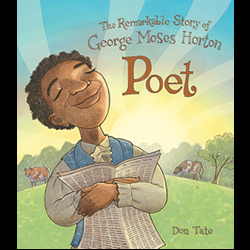
Book Review: The Remarkable Story of George Moses Horton

THE REMARKABLE STORY OF GEORGE MOSES HORTON POET by Don Tate tells the inspiring story of the first southern African-American man to become a published author.
George Moses Horton grew up as a slave working on a farm in North Carolina. After learning to read he began to compose poetry. Although his slave owner refused to set him free, he was able to write and sell his poetry professionally until he was emancipated during the Civil War.
Tate’s attractive illustrations include verses that flow across many pages bringing Horton’s words alive for readers.
Librarians will find this picture book to be an excellent addition to their biography collection. Combine it with other author biographies in a library display. Or, include it in a collection of biographies related to slavery.
Learn more about the author at http://dontate.com/.
Published by Peachtree Publishers on September 1, 2015. Review copy courtesy of the publisher.

Thursday, February 05, 2015

Website Review: Created Equal

CREATED EQUAL is a National Endowment for the Humanities project that brings together award-winning documentary films related to the Civil Rights Movement. It would be a great addition to your Black History Month library activities.
The films include The Abolitionists, Slavery By Another Name, Freedom Riders, The Loving Story, and Freedom Summer. For each film, users can stream the full video, read an overview, and explore background information. In addition, links to classroom materials, essays, and other information is provided.
The website also includes lessons for teachers. Topics include equality under the law, the power of the individual, and the strategy of nonviolence. These lessons are connected to Common Core Standards and include questions for discussions and resources. Guides are also provided for essays related to each film. Additional resources include links to lots of quality websites.
The community programs section provides a programming guide and ideas for how your school and community can participate in events. Events will be held around the US through 2016 including film viewings and a traveling exhibition. An online version of the exhibit is available at http://goo.gl/zyYZK1.
To visit the website, go to http://createdequal.neh.gov/.

Thursday, January 01, 2015

Book Review: Passenger on the Pearl

PASSENGER ON THE PEARL by Winifred Conkling tells the true story of Emily Edmonson’s flight from slavery. The work of nonfiction for youth is an authentic portrayal of the heartbreaking reality of slavery. Readers are immediately immersed in the story as Emily and her sibling’s attempt to escape on a ship called the Pearl. After their unsuccessful quest for freedom, the story continues to follow Emily’s life in slavery as well as the plight of the abolitionists who planned the escape. Ultimately, Emily and her sister are freed, educated, and became abolitionists themselves. They even develop a friendship with Harriet Beecher Stowe, author of Uncle Tom’s Cabin.

The book includes a variety of compelling primary source documents including photographs, paintings, manifests, and posters that dramatically visualize the story. Graphic elements including maps, a timeline, and a family tree that help orient readers. The source notes, bibliography, and index are helpful to young researchers.

Focused fact sheets interwoven into the story help readers understand the laws and practical threats to slaves seeking freedom in the mid 19th century.

Conkling does a masterful job merging the real-world story of Emily with background information about the time period and specific events associated with the famous failed escape. The combination creates both empathy for the runaway slaves as well as an understanding of the context of the escape.

The National Park Service Underground Railroad Map at http://www.nps.gov/subjects/ugrr/discover_history/underground_map.htmprovides a map showing hundreds of locations related to the Underground Railroad.

To learn more about author Winifred Conkling, go to http://www.winifredconkling.com/.

After reading this wonderful book for youth, some teens might be interested in a more in-depth examination of the attempted escape and the aftermath. Read ESCAPE ON THE PEARL (2007) by Mary Kay Ricks, a work of nonfiction for adults.


NetGalley ARC used for review